LECTURE 5
Example
1. Consider as a system, the gas in the cylinder shown
in the figure. The cylinder is fitted with a piston on which number of small
weights is placed. The initial pressure is 200 kPa, and the initial volume of
the gas is 0.04 m2.
1. Let the gas in the cylinder be heated, and let the volume of the gas
increase to 0.1 m3 while the pressure remains constant. Calculate
the work done by the system during this process.

Since the pressure is constant, we
conclude
from the above equation
that

2. Consider the same system and initial condition, but at the same time the
cylinder is being heated and the piston is rising, let the weights be removed
from the piston at such a rate that, during the process the temperature of the
gas remains constant.
If we assume that the ideal-gas model is valid. We note that this is a
polytropic process (PVn=const.) with exponent n = 1.
For such a process,
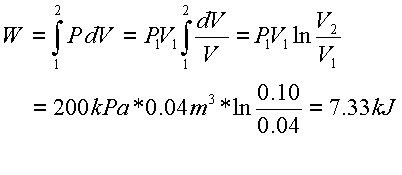
3. For the same system, let the weights be removed at such a rate that the
expression PV1.3 = const. Again the final volume is 0.1 m3.
Calculate the work.

4. Consider the system and initial state as before, but let the piston be
held by a pin so that the volume remains constant. In addition, let heat
transfer take place from the cylinder so that the pressure drops to 100kPa.
Calculate the work.
Since dV = zero, the work is zero
because there is no change in volume.

 Example 2. Consider a piston cylinder arrangement as shown. The piston is
loaded with a mass, mp, the outside atmospheric pressure P0,
a linear spring and a single point force F1. The piston
is restricted in its motion by lower and upper stops trapping the gas with a
pressure P.
Example 2. Consider a piston cylinder arrangement as shown. The piston is
loaded with a mass, mp, the outside atmospheric pressure P0,
a linear spring and a single point force F1. The piston
is restricted in its motion by lower and upper stops trapping the gas with a
pressure P.
For
zero acceleration in a quasi-equilibrium process,

The
piston position for a relaxed spring is x0, which depends on how the
spring is installed.
The
force balance then gives the gas pressure by division with the area, A,
as

To illustrate the process in a P-V diagram, the
distance x is converted to volume by division and multiplication with A:

This relation gives
the pressure as a linear function of the volume with slope of C2=k/A2
The work in a quasi-equilibrium process, is

With P`1 = P1
and P'2 = P2 subject to the constraint that

An part of the process with a pressure smaller
that Pmin or larger than Pmax does not
involve work.


Example 3. Balloon initially collapsed
and flat. Slowly filled with helium from a cylinder
Dia
= 5 m.
Ambient
pressure = 100 kPa
Temperature
const. = 300 K
System:
Helium contained in cylinder and balloon.
Filling
process quasi-static
Work
done by Helium , W
