Clausius inequality can be used to analyze the cyclic process in a quantitative manner. The second law became a law of wider applicability when Clausius introduced the property called entropy. By evaluating the entropy change, one can explain as to why spontaneous processes occur only in one direction.
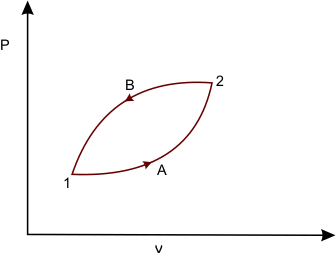
Figure 22.1
Consider a system in initial state 1. Let the system be taken from state 1 to state 2 along a reversible path 1-A-2, and then be restored to its initial state by following another reversible path 2BI (Figure 22.1). Then the two paths put together form a reversible cycle 1A2BI. Apply the Clausius inequality to this reversible cycle and obtain
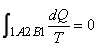 |
(22.1) |
or,
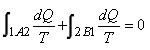 |
(22.2) |
or,
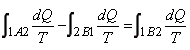 |
(22.3) |
Since path 2B1 is reversible, the limits of the integral can be reversed. That is,  has the same value whether the path followed is 1A2 or 1B2. It is possible to connect the states 1 and 2 by several reversible paths and see that has the same value irrespective of the path as long as the paths are reversible. Therefore has the same value whether the path followed is 1A2 or 1B2. It is possible to connect the states 1 and 2 by several reversible paths and see that has the same value irrespective of the path as long as the paths are reversible. Therefore  is an exact differential of some function which we identify as entropy. Hence it can be said that there exists a function S, called entropy, the change in entropy is expressed as is an exact differential of some function which we identify as entropy. Hence it can be said that there exists a function S, called entropy, the change in entropy is expressed as
 |
(22.4) |
This follows from the Clausius inequality as a consequence of the second law of thermodynamics. Therefore
 (for reversible process only) (for reversible process only) |
(22.5) |
|


