Research · Lean premixed combustion

Lean premixed combustion

Lean premixed flames cut NOx but sit close to blowout and thermoacoustic instability. We build swirl-stabilized combustors, run them on natural gas and hydrogen, and use high-speed laser diagnostics and large eddy simulation to understand what keeps a lean flame alive.

Background: OH-PLIF frames of a stable flame, φ = 0.58

Flame dynamics

Time-resolved OH-PLIF of a lean premixed CNG–air swirl flame. OH marks the hot reacting zones. Both sequences are slowed down for viewing.

Stable flame · φ = 0.58 · a compact, well-anchored reaction zone
Unstable flame, close to blowout · φ = 0.52 · fragmented pockets, local extinction and re-ignition
Bulk velocity, Ub
10.2 m/s
Bulk temperature, Tb
500 K
Pressure
1 bar
Swirl number
0.7
Diagnostic
OH-PLIF at 5 kHz with an intensified high-speed camera

The combustor

A lean premixed, swirl-stabilized gas turbine combustor developed in the lab for high-hydrogen-content fuels.

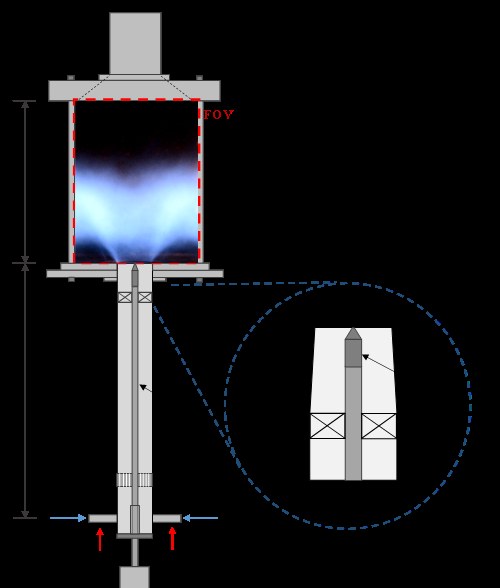
Schematic of the swirl combustor: fuel and air inlets at the bottom, a long premixing tube with swirler and bluff body, and an optical chamber with the flame and the camera field of view
Combustor schematic with the swirler and bluff body (inset) and the optical field of view (red)

Fuel and air enter at the base and premix along a long tube. The flow passes an axial swirler and a bluff body before expanding at the dump plane into an optically accessible chamber, where the flame stabilizes. Multiple fuel injection ports let us run fully premixed CNG/H2 blends, or inject hydrogen separately for partially premixed operation, all the way to pure hydrogen.

  • Ultra-low-NOx lean premixed operation
  • CNG, CNG/H2 blends and 100% H2
  • Interchangeable bluff bodies to study shape and recess length
  • Preheated air to study inlet temperature effects
Hydrogen widens the lean limit

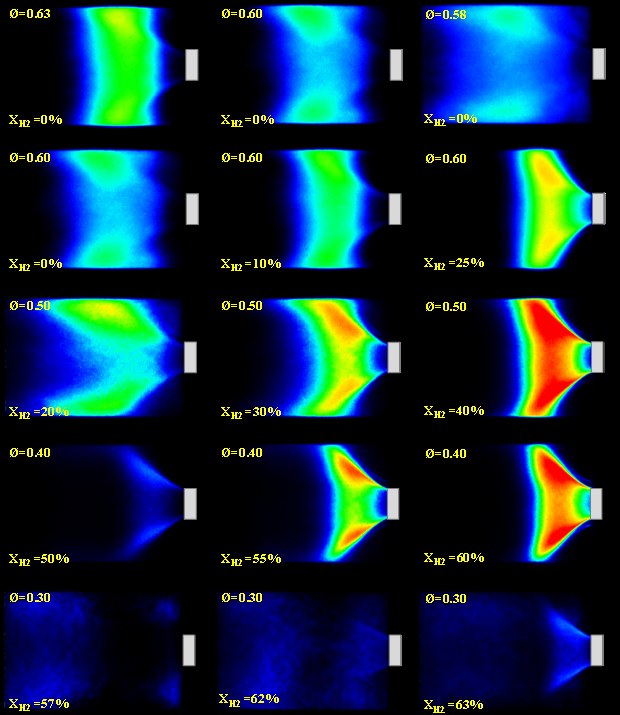
Mean OH* chemiluminescence flame shapes from the high-speed camera at 1 kHz, as the equivalence ratio φ falls and the hydrogen fraction XH2 in the fuel rises.

Grid of fifteen mean OH chemiluminescence images at equivalence ratios from 0.63 to 0.30 and hydrogen fractions from 0 to 63 percent
T = ambient, P = 1 bar, Ub = 10.2 m/s, SN = 0.7 · CNG/H2/air

With natural gas alone the flame weakens and lifts as the mixture gets leaner. Adding hydrogen pulls the flame back onto the bluff body as a compact, intense V-shape, and keeps it burning at mixtures where natural gas alone would blow out.

φ = 0.60
XH2 = 25% gives a compact, attached flame
φ = 0.50
flame intensifies as XH2 rises from 20% to 40%
φ = 0.40
a strong flame needs XH2 ≈ 55–60%
φ = 0.30
only a weak flame survives, even at XH2 = 63%

Laser diagnostics

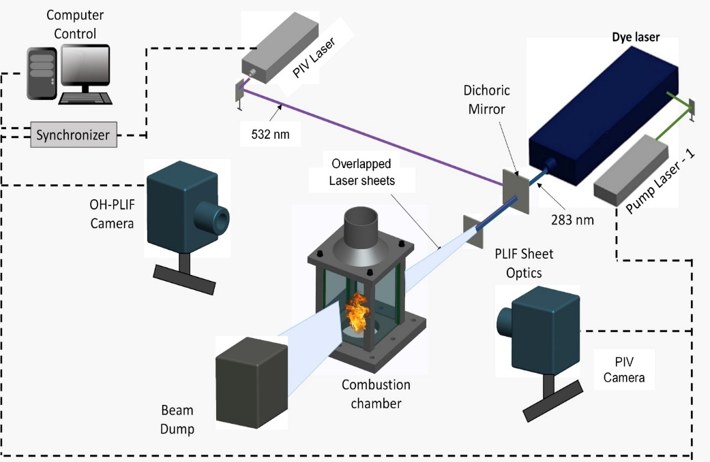
Simultaneous high-speed OH-PLIF and PIV give the flame front and the flow field in the same plane at the same instant.

Diagnostics layout: a dye laser pumped by a pump laser produces a 283 nm sheet for OH-PLIF, a 532 nm PIV laser sheet is overlapped with it through a dichroic mirror into the combustion chamber, with OH-PLIF and PIV cameras on either side and a synchronizer linking all units
A pumped dye laser at 283 nm excites OH; a 532 nm PIV laser sheet is overlapped through a dichroic mirror; a synchronizer triggers both cameras

What we have learned

Hydrogen addition

A hydrogen-rich kernel holds the flame

Adding a small amount of H2 in partially premixed mode creates a hydrogen-rich kernel at the flame base. The kernel resists the high strain rates there and markedly extends the lean stability limit, more than the same hydrogen added fully premixed.

Flameholder geometry

Bluff body shape and recess matter

The shape of the bluff body and how far it is recessed from the dump plane change the recirculation zone, the flame shape and the stability limit of lean CNG–air swirl flames.

Near blowout

Extinction and re-ignition

Close to lean blowout the flame breaks into pockets that repeatedly extinguish and re-ignite, as the OH-PLIF sequences show. Proper orthogonal decomposition of high-speed images separates these events from self-sustained combustion oscillations, and shows how air preheating (305 K vs 450 K) changes the dominant modes.

Simulation

LES of combustion instability

Our OpenFOAM LES with Eulerian Stochastic Fields, validated on the PRECCINSTA combustor, separates a stable flame (25 kW, φ = 0.70) from a self-excited oscillation at 290 Hz (30 kW, φ = 0.83). Transported-FDF LES and new ESF closures now target thermoacoustic and hydrodynamic instabilities in our own combustor.

Publications

  • 2026N. Huda, K. Yadav, A. K. Gupta, S. De. Effects of premixed and partially premixed hydrogen addition on lean CNG–air swirl flames near blowout. International Journal of Hydrogen Energy 242, 155312.Publisher ↗
  • 2023N. Huda, S. K. Soni, S. De. Effects of recess length of bluff body on lean-premixed swirl-stabilized CNG-air flame structure. ASME Gas Turbine India Conference, Bangalore.Publisher ↗
  • 2023N. Huda, S. K. Soni, S. De. The effect of H2 addition on CNG/H2-air flame shape topology in a lean-premixed swirl stabilized gas turbine combustor. ASME Gas Turbine India Conference, Bangalore.Publisher ↗
  • 2023N. Huda, K. Yadav, S. Soni, S. De. Effects of the bluff body shapes on the stability limit of lean premixed CNG-air swirl flames. FMFP 2023.Find paper ↗

All publications →

Funding

  • DST Hydrogen & Fuel CellLean premixed swirl-stabilized combustor for high-hydrogen-content fuel, 2020 – 2025
  • SERB – CRGEffects of shear and stratification on swirling H2/CNG–air flames, 2021 – 2025
  • ANRF – ARGNH3/H2 flames in an RQL combustor, 2026 – 2029

People

  • Dr. Noorul HudaH2-enriched lean premixed and partially premixed flames (PhD 2026)
  • Krishna Chaitan MarthiThermoacoustic and hydrodynamic instabilities
  • Keshav YadavFlame stabilization and laser diagnostics
  • Pabitra Kumar BhuyianExperimental diagnostics of a dual swirl burner
  • Sarvesh MauryaLES-ESF simulations of turbulent combustion

Awards

  • Best Paper Award in Fluid Power, FMFP 2024N. Huda and co-workers
  • First Prize, Poster, ASME GT India 2023K. C. Marthi and S. De