Research · Turbulent combustion modeling

MMC-LES of reactive flows

Multiple Mapping Conditioning (MMC) is a probability density function approach to turbulent combustion. Coupled with large eddy simulation, it lets us predict flames that ignite, extinguish and re-ignite, in gaseous jets and spray flames. Our solvers are built in OpenFOAM.

Background: instantaneous temperature in a piloted jet flame with three mixing models

The approach

LES resolves the large turbulent eddies and models the rest. Combustion, however, happens at the smallest scales, where fuel and oxidizer mix molecularly. MMC represents that unresolved mixing with stochastic particles that carry the full thermochemical composition.

The key idea is to localize mixing in composition space. Each particle is conditioned on a reference variable, here the LES-filtered mixture fraction, and mixes only with particles that are close to it in that reference space. This keeps the particles from mixing across the flame, which is what lets MMC capture local extinction.

Because the particles are only weakly tied to the LES grid, the sparse-Lagrangian implementation uses far fewer particles than grid cells, which makes detailed chemistry affordable.

A dynamic mixing time-scale model

Particles in MMC relax towards each other over a minor mixing time scale. This time scale sets the level of compositional fluctuation, and with it whether a model predicts local extinction. It is modeled from the particle separation in reference space, dx, and the molecular and sub-filter diffusion:

τL=f′2~LχL=Cfdx2𝒟+𝒟sgs,L

The coefficient Cf is usually a fixed constant. In our dyn-aISO model it is computed locally instead. At the grid filter Δ, the sub-filter variance of mixture fraction is modeled as

ρ‾f′2~=ρ‾ff~−ρ‾f~f~=ρ‾CfΔ2|∇f~|2

and the same model is written at a test filter Δ^=2Δ. Because the difference between the two filter levels is resolved, it gives an identity from which Cf follows directly, with no tuning:

ℒ=ρ‾f~f~^−ρ‾^fˇfˇ=Cfℳ,Cf=|ℒ·ℳ||ℳ·ℳ|

The coefficients for the sub-filter scalar variance and its dissipation therefore adapt to the local flow, which is what lets the model follow flames from strong burning to near extinction.
Gaseous flames with local extinction

Sandia piloted CH4/air jet flames, a standard test of a model's ability to capture extinction and re-ignition.

Three instantaneous temperature fields of a piloted jet flame computed with three mixing time-scale models
Instantaneous temperature with the st-aISO, dyn-aISO and stCf-aISO mixing models

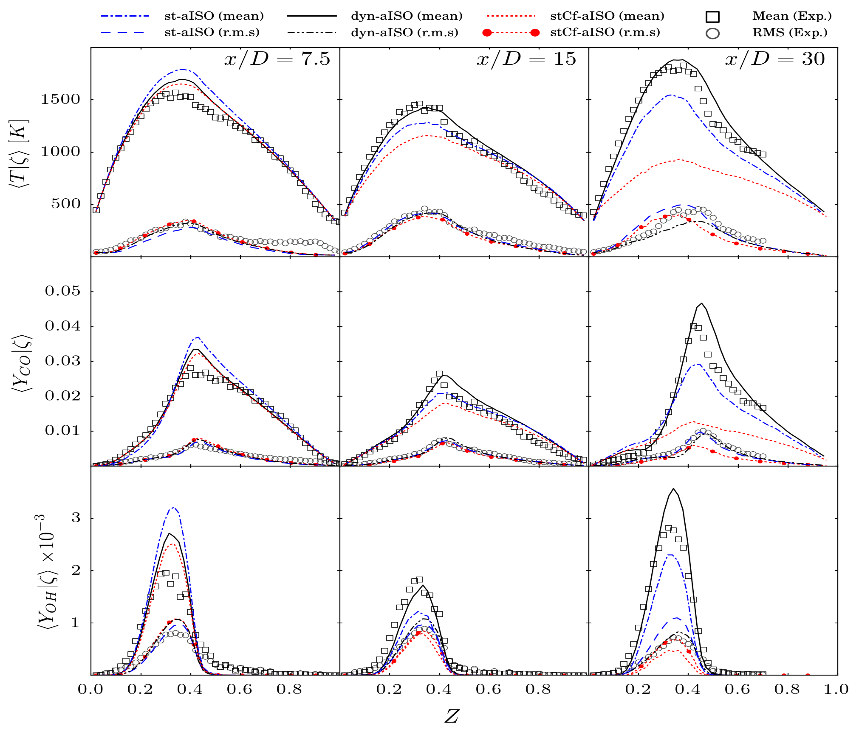
The fixed-coefficient models either over-predict burning or extinguish too much. With the dynamic model, the predicted level of local extinction, and the re-ignition further downstream, follow the measurements across the flame series.

Conditional mean temperature and species against mixture fraction at three axial stations compared with measurements
Conditional means against mixture fraction at x/D = 7.5, 15 and 30, compared with experiment

Sharma, De & Cleary, Combust. Flame 238 (2022) 111872

Spray flames

Sydney piloted ethanol spray flames (AcF series), with evaporating droplets tracked as Lagrangian parcels and two-phase MMC for the gas-phase chemistry.

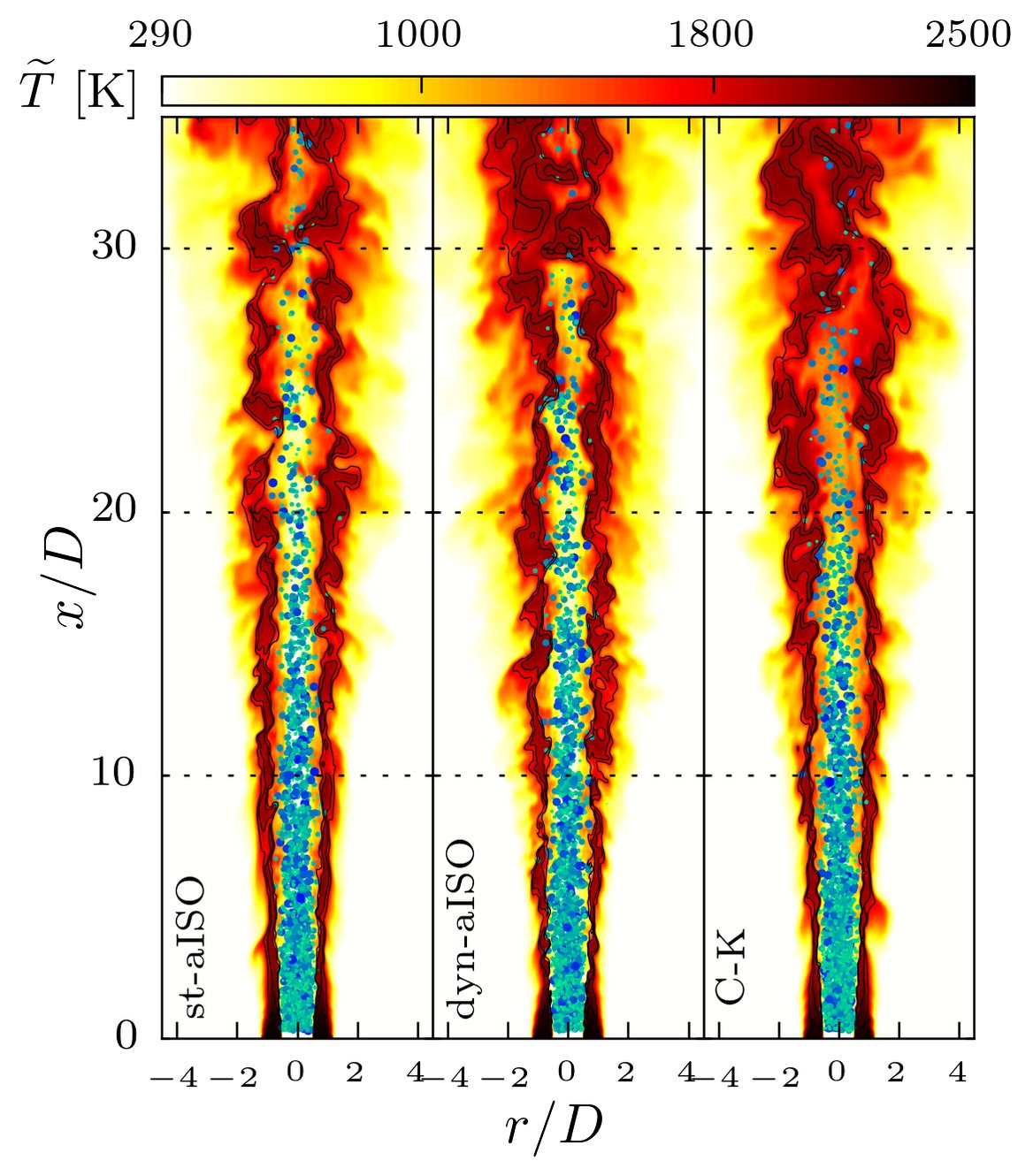
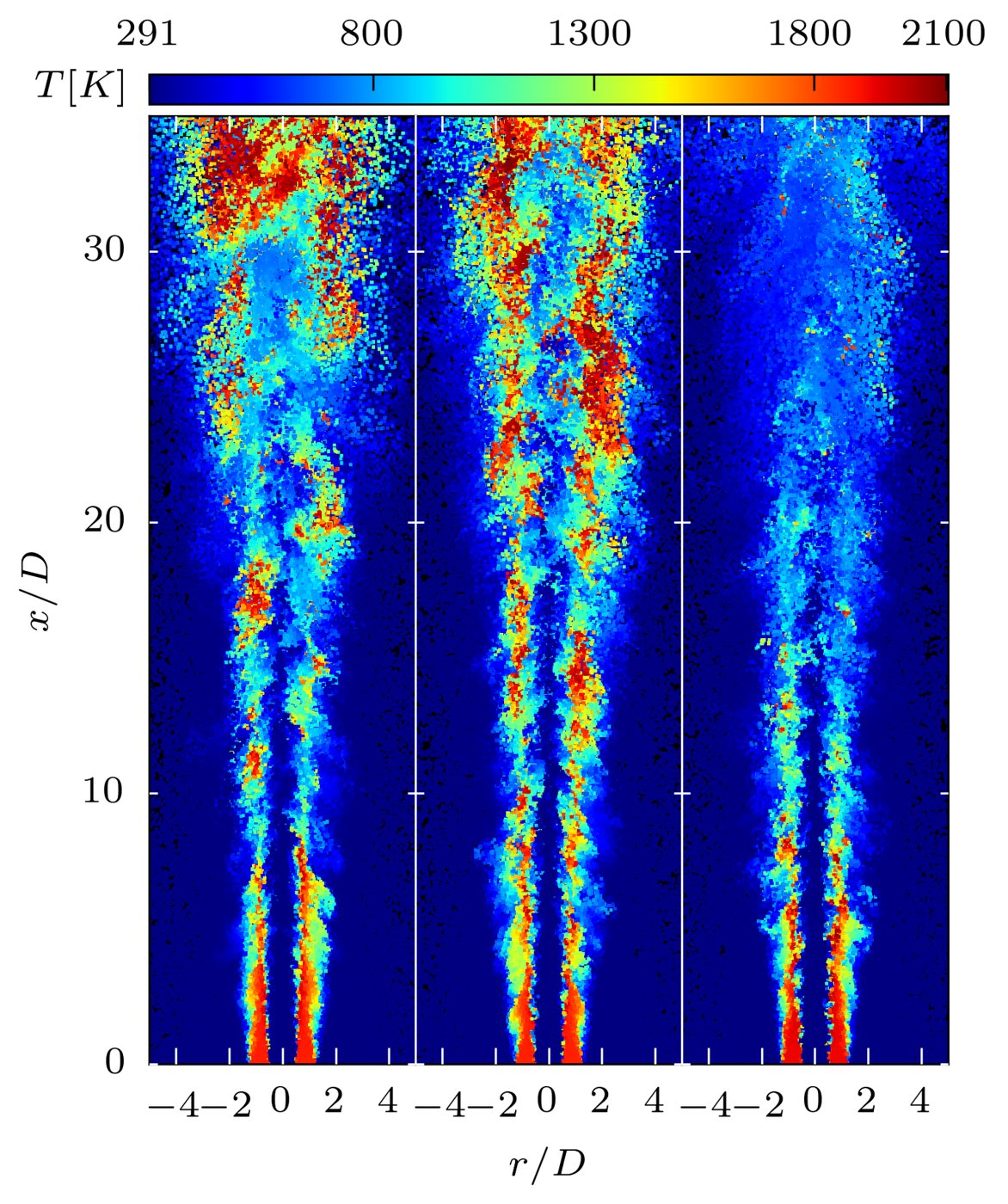
Three instantaneous temperature fields of the ACF7 spray flame for three mixing models
AcF7 spray flame: temperature with st-aISO, dyn-aISO and C-K mixing models

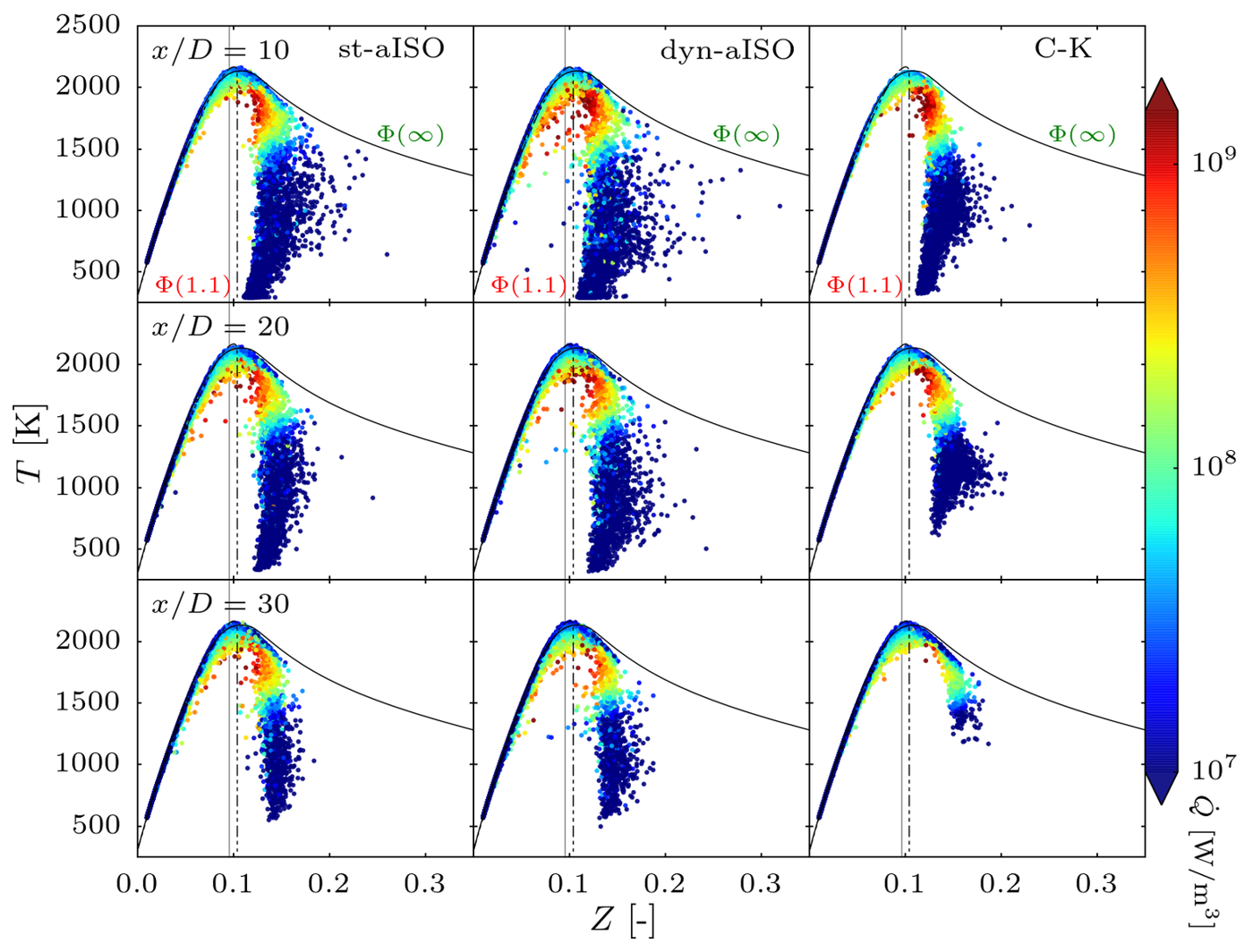
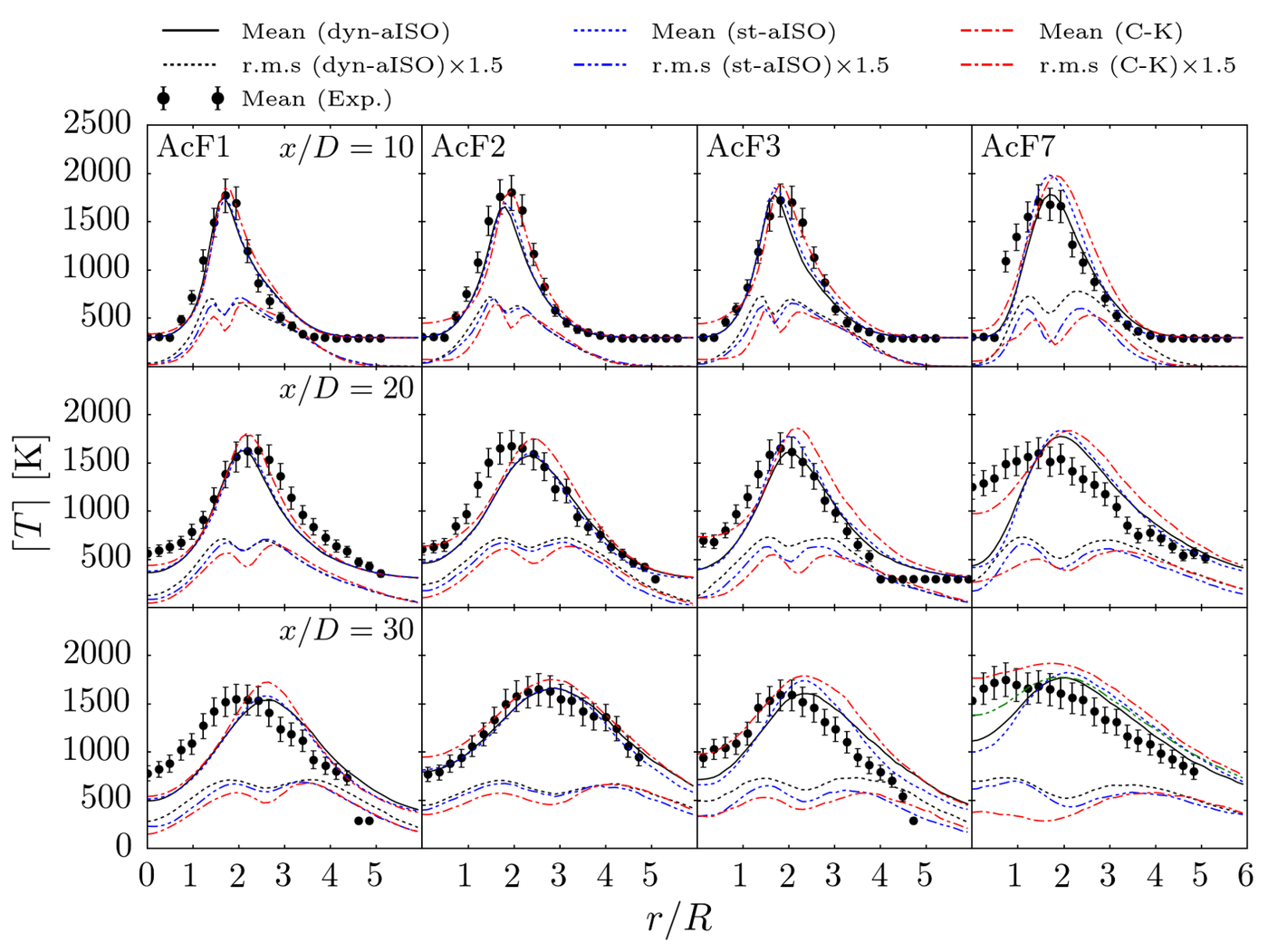
The dynamic time-scale model carries over to sprays, where evaporation adds a second source of mixture-fraction fluctuations. Scatter plots of temperature against mixture fraction show how each model spreads the particles between burning and extinguished states, and the radial temperature profiles are compared across four flames of the series.

Scatter plots of temperature against mixture fraction at three axial stations for three models
Temperature against mixture fraction at x/D = 10, 20 and 30

Sharma & De, Combust. Flame 251 (2023) 112708
Sharma, De & Cleary, Proc. Combust. Inst. 38 (2020) 3399

Mean and rms radial temperature profiles for flames AcF1, AcF2, AcF3 and AcF7 at three stations compared with measurements
Mean and rms temperature for AcF1, AcF2, AcF3 and AcF7 against measurements
MMC-LES of a spray flame as it develops, four views side by side: droplet diameter, temperature, OH mass fraction, and the stochastic MMC particles coloured by CO2 mass fraction

Where it started: stochastic MMC in RANS

Before moving to LES, the group developed RANS-based stochastic MMC for lifted jet flames in vitiated coflows, auto-igniting CH4/air and dimethyl ether flames, and turbulent premixed combustion. These studies laid the groundwork for the sparse-Lagrangian MMC-LES solvers.

Publications

  • 2023E. Sharma, S. De. MMC-LES of spray combustion: Analysis of mixing timescales and flame structure. Combustion and Flame 251, 112708.Publisher ↗
  • 2022E. Sharma, S. De, M. J. Cleary. A fully dynamic mixing time-scale model for the sparse Lagrangian multiple mapping conditioning approach. Combustion and Flame 238, 111872.Publisher ↗
  • 2022P. Breda, E. Sharma, S. De, M. J. Cleary, M. Pfitzner. Coupling the multiple mapping conditioning mixing model with reaction-diffusion databases in LES of methane/air flames. Combustion Science and Technology 195(2), 351–378.Publisher ↗
  • 2020E. Sharma, S. De, M. J. Cleary. LES of a lifted methanol spray flame series using the sparse-Lagrangian MMC approach. Proceedings of the Combustion Institute 38(2), 3399–3407.Publisher ↗
  • 2024S. K. Ghai, R. Gupta, S. De. Effects of partial premixing and coflow temperature on flame stabilization of lifted jet flames of dimethyl ether in a vitiated coflow based on stochastic multiple mapping conditioning approach. Fluids 9(6), 125.Publisher ↗
  • 2019S. K. Ghai, S. De. Numerical investigation of flow and scalar fields of piloted, partially-premixed dimethyl ether/air jet flames using stochastic multiple mapping conditioning approach. Combustion and Flame 208, 480–491.Publisher ↗
  • 2019S. K. Ghai, S. De. Numerical investigation of auto-igniting turbulent lifted CH4/air jet diffusion flames in a vitiated co-flow using a RANS based stochastic multiple mapping conditioning approach. Combustion and Flame 203, 362–374.Publisher ↗
  • 2019S. K. Ghai, S. De. Numerical modelling of turbulent premixed combustion using RANS based stochastic multiple mapping conditioning approach. Proceedings of the Combustion Institute 37, 2519–2526.Publisher ↗
  • 2019S. K. Ghai, S. De, A. Kronenburg. Numerical simulations of turbulent lifted jet diffusion flames in a vitiated coflow using stochastic multiple mapping conditioning approach. Proceedings of the Combustion Institute 37, 2199–2206.Publisher ↗
  • 2016C. Straub, S. De, A. Kronenburg, K. Vogiatzaki. The effect of timescale variation in multiple mapping conditioning mixing of PDF calculations for Sandia Flame series D–F. Combustion Theory and Modelling 20(5), 894–912.Publisher ↗
  • 2015K. Vogiatzaki, S. Navarro-Martinez, S. De, A. Kronenburg. Mixing modelling framework based on multiple mapping conditioning for the prediction of turbulent flame extinction. Flow, Turbulence and Combustion 95(2), 501–517.Publisher ↗

All publications →

People

  • Dr. Eshan SharmaDynamic mixing time-scale model, MMC-LES of gaseous and spray flames (PhD 2022)
  • Dr. Sanjeev Kumar GhaiStochastic MMC for multi-regime flames (PhD 2019)
  • Sarvesh MauryaLES-ESF simulations of turbulent combustion

Collaborators

  • Prof. Matthew J. ClearyUniversity of Sydney
  • Prof. Assaad R. MasriUniversity of Sydney
  • Prof. Andreas KronenburgUniversity of Stuttgart