THEORY/MATHEMATICAL MODELLING
Approximate analytical solution for binary composite dissolution kinetics
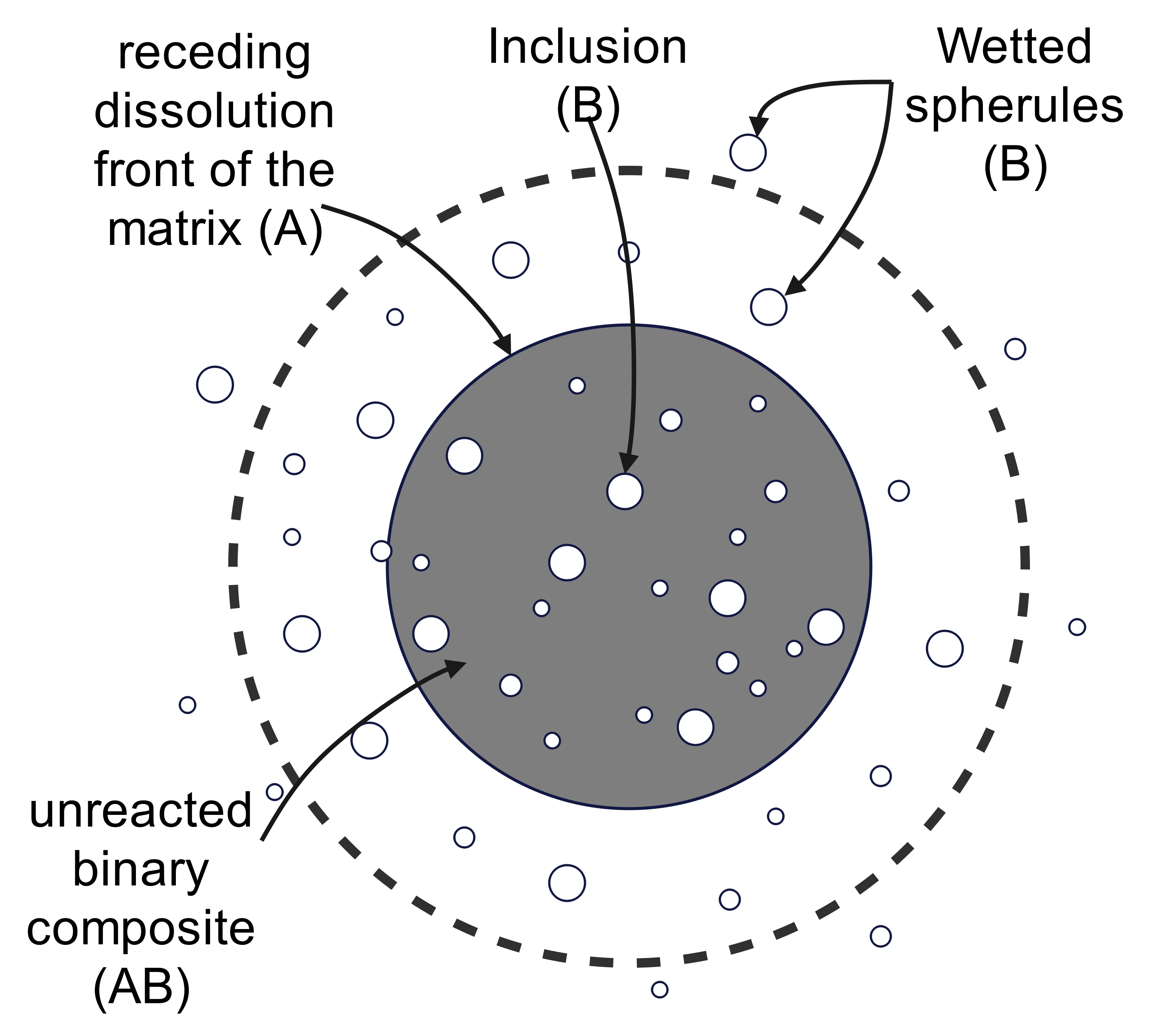
© R. Ragipani. An illustration showing major (A) and minor (B) phases in binary composite depicted as a spherical particle with polydisperse spherule inclusions.
Multi-mineral composites are ubiquitous in natural and engineering environments. Examples include controlled-release drugs, metallurgical slags, and natural rocks. Understanding the influence of intra-particle heterogeneity on dissolution characteristics is required for developing process and product design strategies.
In this work, we used population-balance model to describe binary composite dissolution and obtained an analytical solution with some simplifications. An analytical solution describes dissolution kinetics of major and minor phases. Obtained expression for conversion vs time accurately describes controlled-release drug dissolution, and leaching of steel slag.
Learn more from ChemRxiv preprint
PILOT PROJECT
Pilot demonstration unit for Integrated Carbon Capture and Mineralization (ICCM)
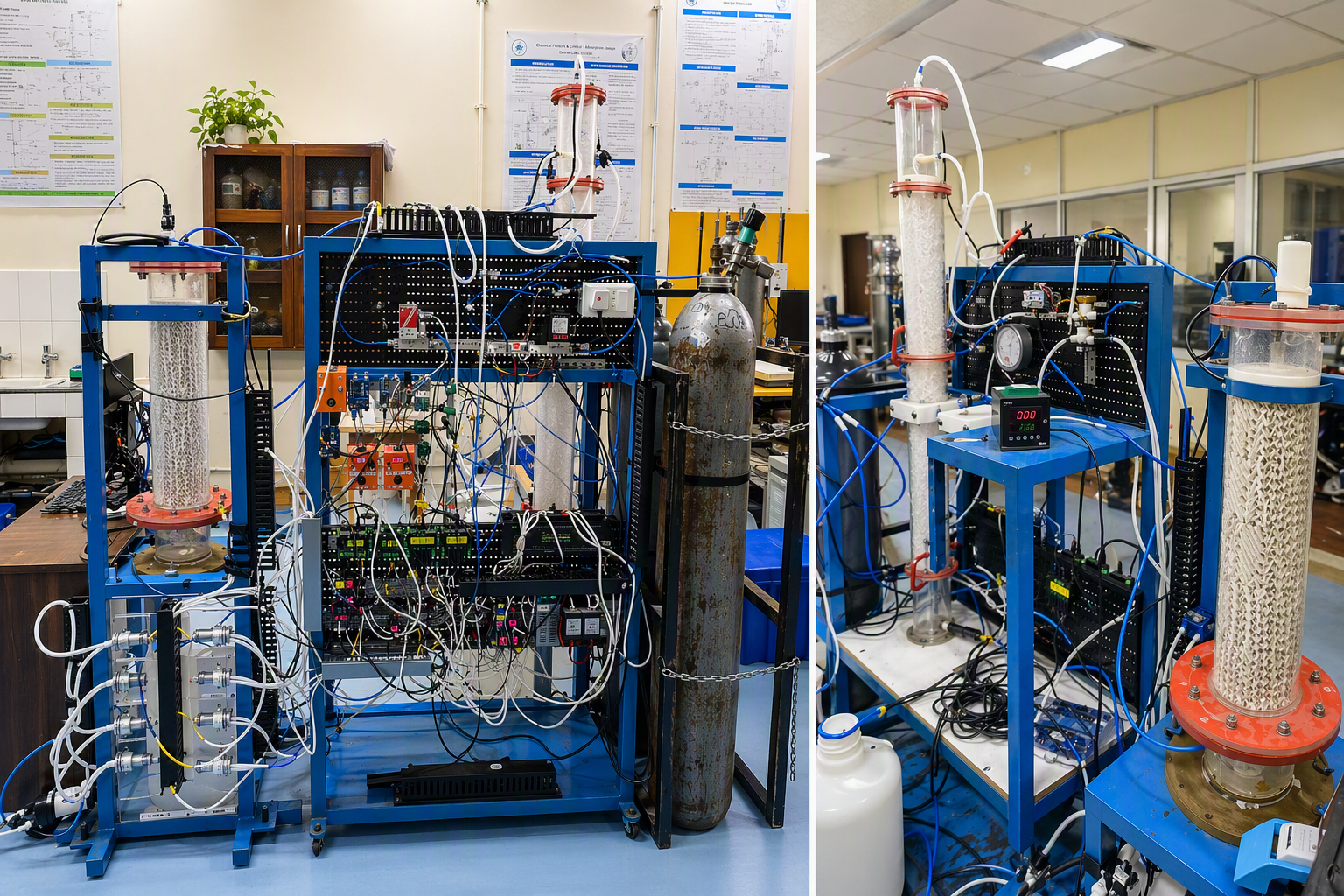
© R. Ragipani. Disclaimer: Brightness/contast/cropping of the image was improved using Copilot. Any distortion by AI tool was unintentional.
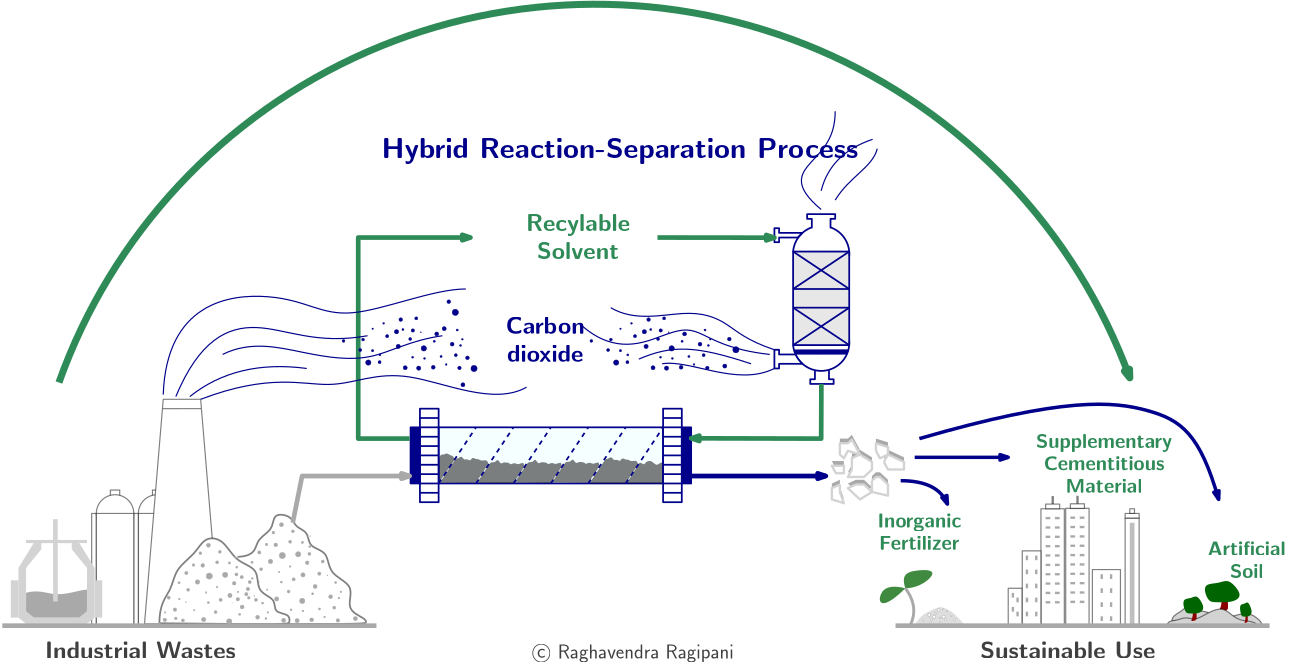
Integrated carbon capture and mineralization (ICCM) technology is a two-step process for absorption-based CO2 separation and its storage as carbonates. This process operates at room temperature and atmospheric pressure without any additional heat input.
A 2 kg CO2/day pilot unit was setup for demonstration and scaleup studies. The pilot unit has several in-situ probes for tracking performance of absorption and mineralization process. The setup has significant automation and digital work flows for ease of operation. Recently, we conducted a study using various industrial slag samples to evaluate their suitability for this process.
Learn more
PILOT PROJECT/ FIELD DEMONSTRATION
Making artificial soil using steel slag and its demonstration
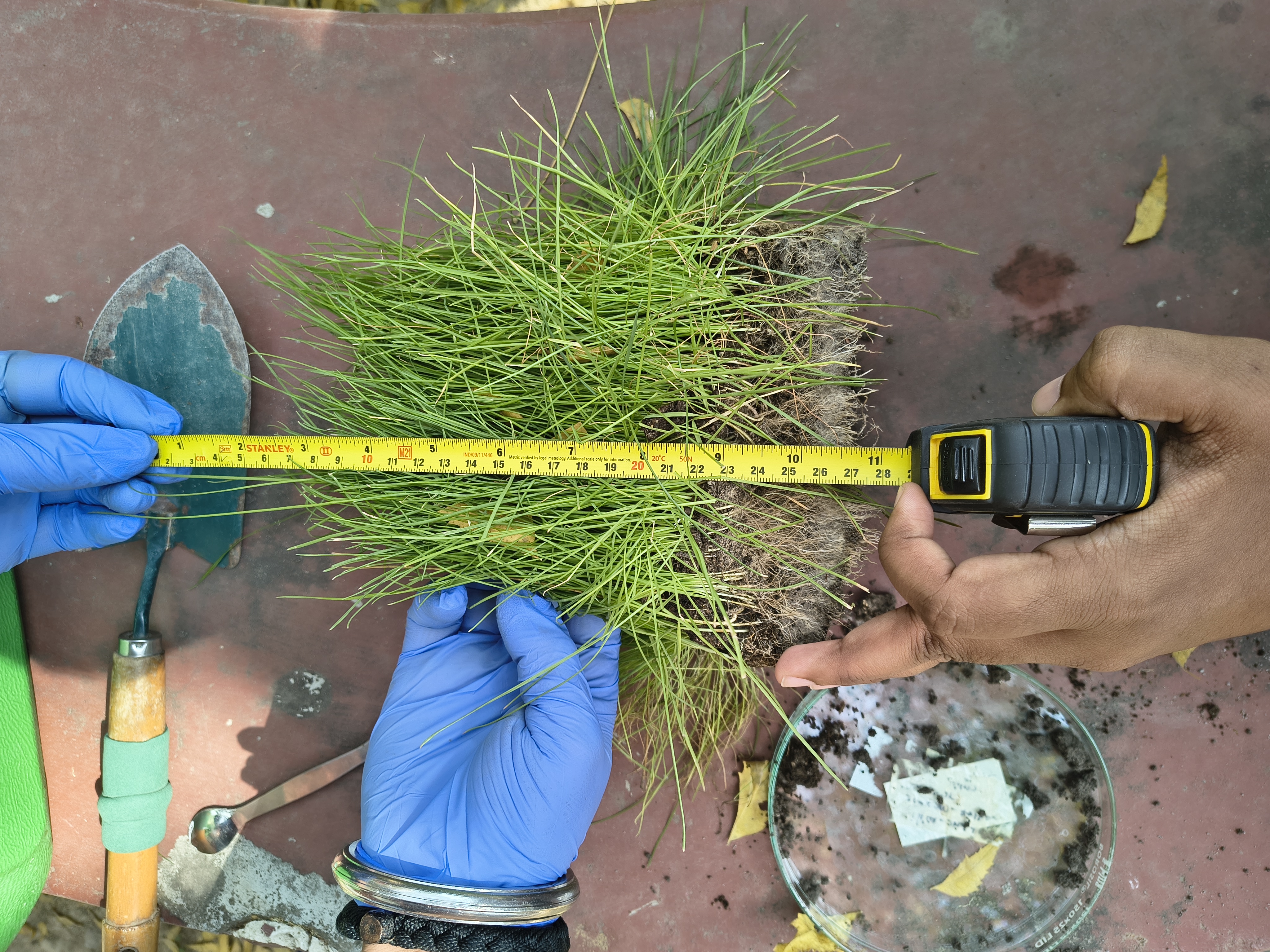
© R. Ragipani. Bermuda grass grown in artificial slag soil showing good survival and robust growth.
Steel slags are silicate-based industrial wastes with suitable chemical constituents and physical characteristics for conversion to soil. In this work we transformed highly alkaline BOF slag that is unfriendly for plant growth into a more benign soil that supoorts growth of vegetation. As a pilot project, we produced more than 100 kg of artificial slag soil and successfully field tested it for 6 months showing robust growth of bermuda grass. This work was carried out with grant-in-aid from USISTEF and in collaboration with UW-Madison and TREE Green Solutions Pvt. Ltd, Hubli.
Without the need for regular top soil, artificial slag soil can be used to reclaim abandoned mines and promote circularity.
MATHEMATICAL MODELLING/PROCESS SIMULATIONS
Aspen Custom Model for membrane-based gas separation
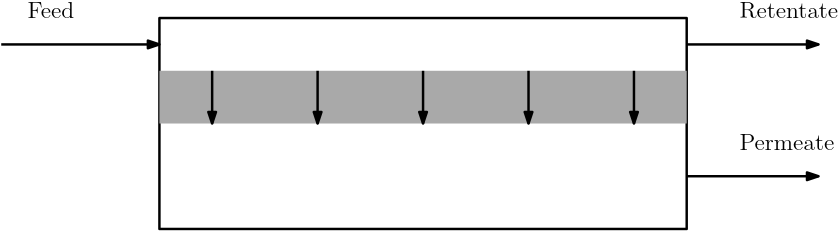
© R. Ragipani. An illustration showing membrane-based gas separation.
Membrane-based gas separation systems are widely used in industrial applications such as biogas upgradation, carbon dioxide capture, and air separation. Currently, process simulators such as Aspen Plus do not have user friendly membrane model supporting rigorous evaluation of membrane separation.
We developed a custom model for gas separation capable of simulating gas-separation to estimate required membrane area and paermeate/retentate composition for a given gas feed its flow pattern. This module can be used for simulating pressure-driven, vacuum-driven multi-stage membrane modules with recycle streams. This detailed module is especially useful for productivity calculation, rigorous comparison with competiting separation technologies and technoeconomic evaluation.
In recent work (Anshika and Ragipani, Separation and Purification Technology, 2026), we used this model for designing a hybrid separation process combining membrane separation with absorption.
EXPERIMENTAL STUDY/PROCESS SIMULATIONS
Packed-bed setup for CO2 capture solvent testing
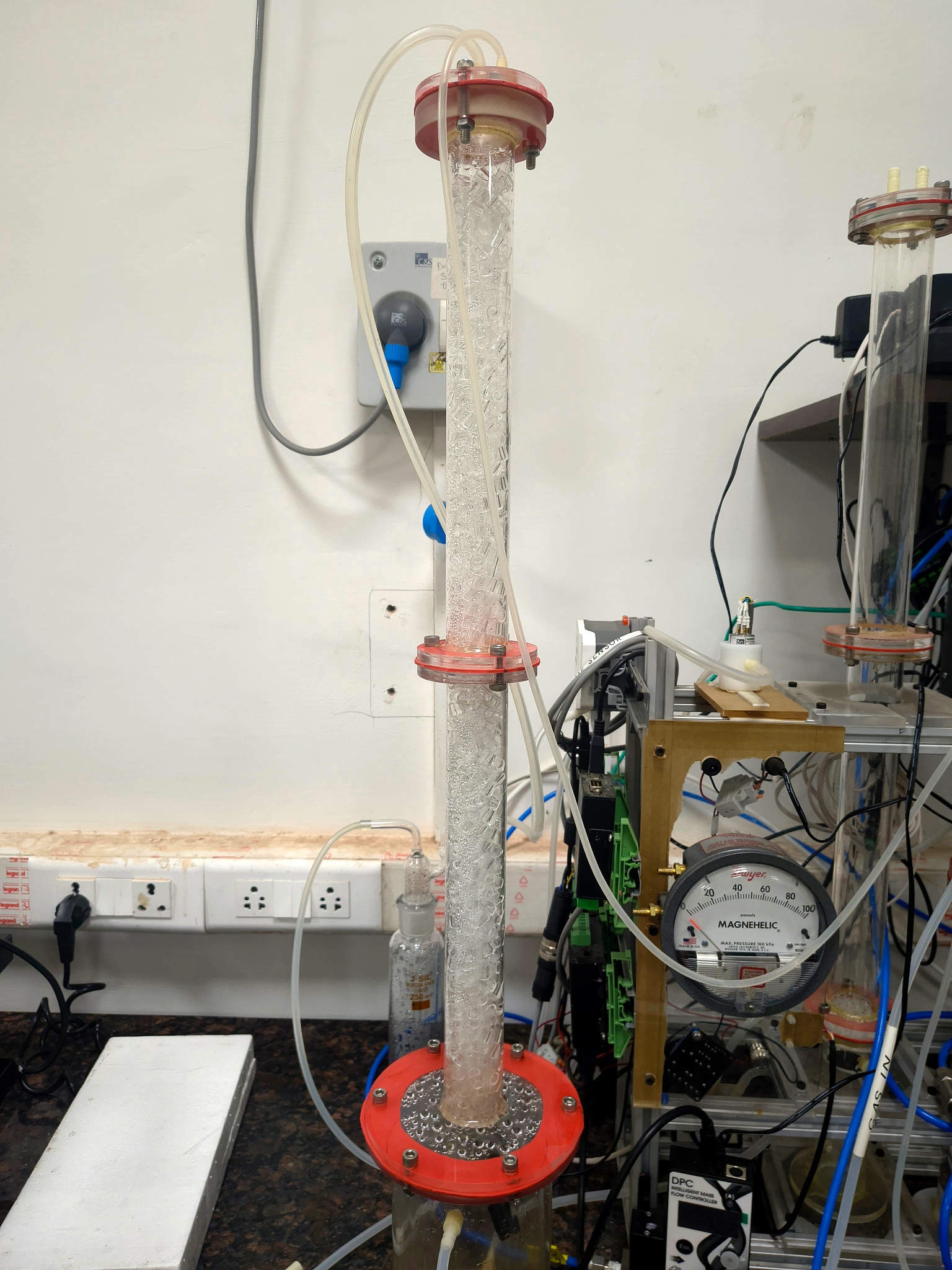
© R. Ragipani. Packed column apparatus with raschig rings for studying CO2 absorption
A packed column setup with raschig rings for studying gas-liquid absorption kinetics and evaluating performance of solvent blends. The apparatus is equipped with provision to blend two gases and humidify it.
The system is equipped with online sensors and inhouse developed digital data acquisition and control platform for tracking absorption kinetics and column hydraulics. The digital data acquisition and control platform also enables for high-throughput scheduling of design of experiments without manual intervention.
EXPERIMENTAL STUDY
Packed column apparatus for studying Direct Air Capture (DAC) of CO2
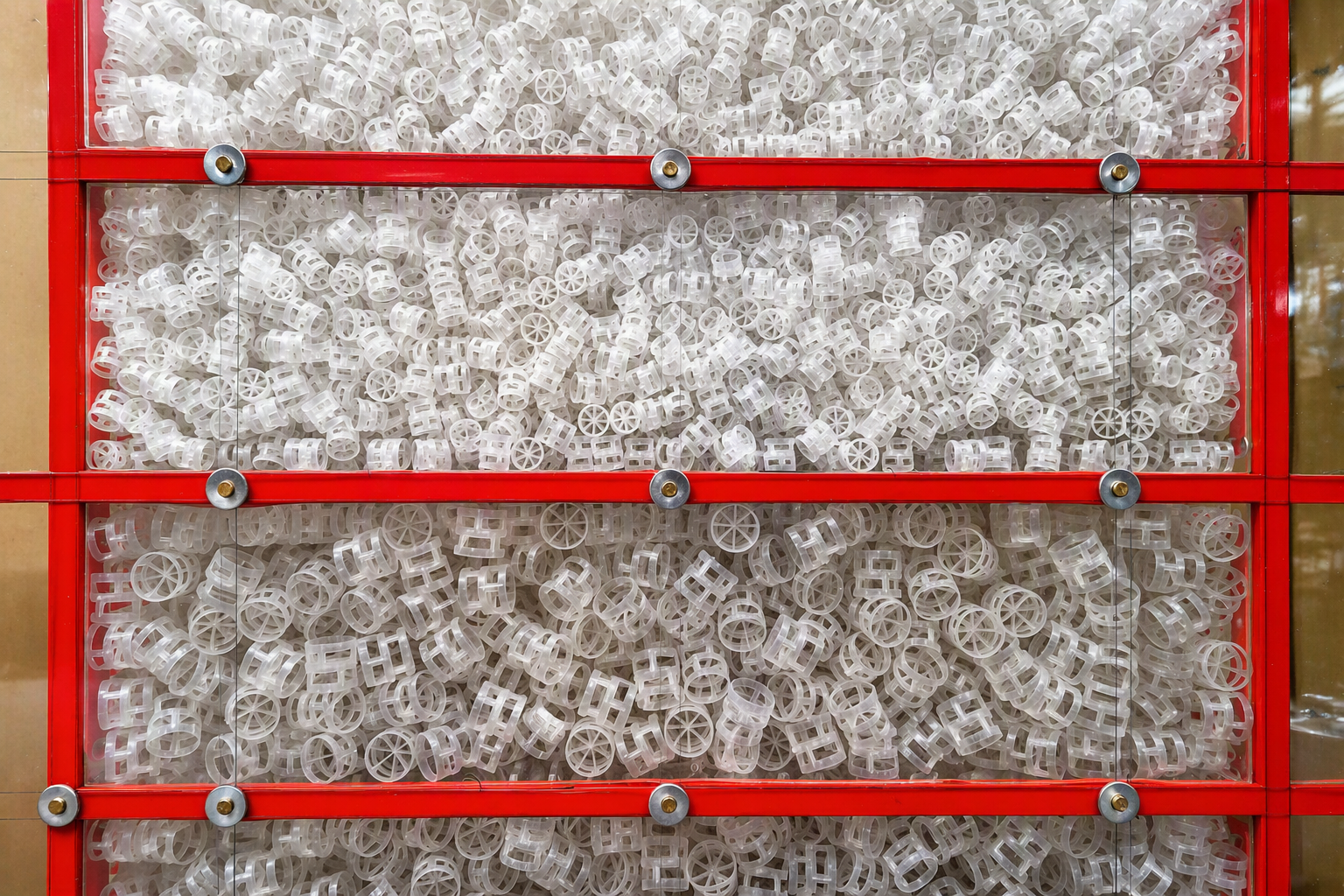
© R. Ragipani. Plastic random packings (pall ring) of varying sizes shown in a pilot-scale DAC unit.
This inhouse developed experimental DAC setup can handle air inflow rates exceeding 100 kg/h with a provision for humidification. The apparatus has corrosion-resistant random packings for mass transfer.
The setup is equipped with several sensors to track solvent performance, carbon dioxide removal kinetics, hydraulics, temperature changes and water evaporation rate. The system is integrated with inhouse digital data acquisition and control system for continuous operation.