Research · Aerospace propulsion

Flame stabilization in a jet engine afterburner

An afterburner reheats the exhaust of a jet engine to boost thrust. Its flame must hold on V-gutter flameholders in a fast, hot, vitiated stream, close to blowout and prone to combustion instability. We are building an afterburner test rig with laser diagnostics to see how these flames anchor, interact with turbulence and lose stability.

Background: afterburner test section with V-gutter flameholder

The test rig

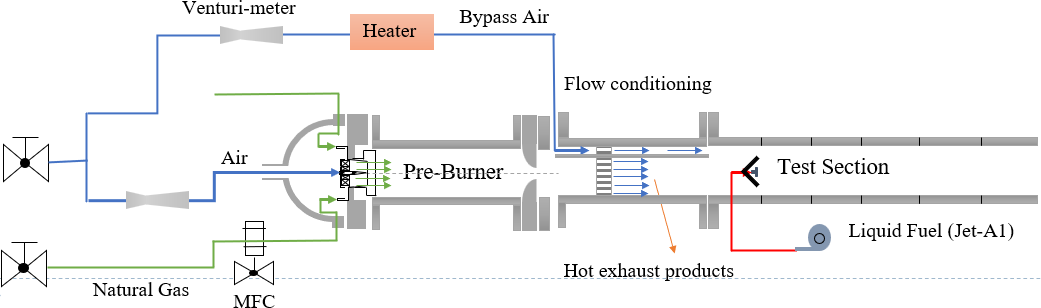
Rig layout: air and natural gas feed a pre-burner, followed by flow conditioning, a bypass air stream from a heater, and the test section with liquid Jet-A1 injection
Rig layout: a natural-gas pre-burner produces hot vitiated air, which passes flow conditioning into the test section; a heated bypass stream and Jet-A1 injection complete the arrangement
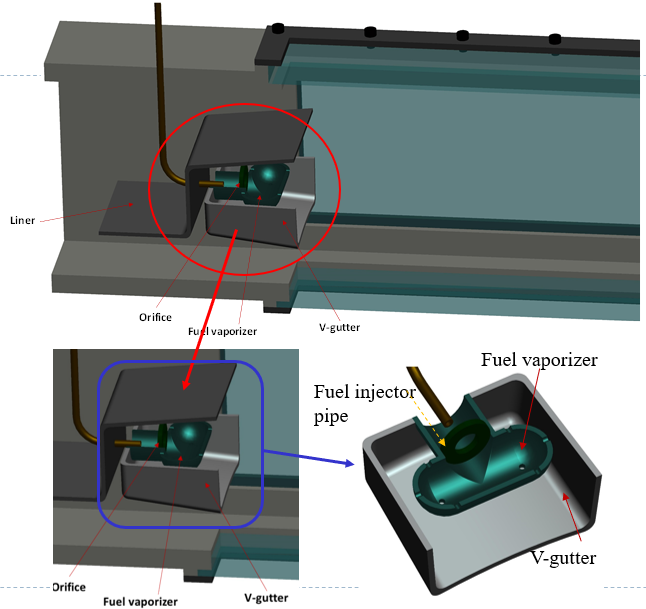
CAD of the test section showing the liner, orifice, fuel vaporizer and V-gutter, with close-ups of the fuel injector pipe and the T-shaped vaporizer inside the V-gutter
Test section: V-gutter flameholder with a T-vaporizer fed by a fuel injector pipe

A natural-gas pre-burner heats the air and lowers its oxygen content, reproducing the vitiated exhaust that reaches a real afterburner. After flow conditioning, the stream enters an optically accessible test section, where liquid Jet-A1 is injected through a T-shaped vaporizer into a V-gutter flameholder. A separate heated bypass stream represents the engine bypass flow.

The rig is designed to cover realistic afterburner inlet conditions: static pressures of 1 to 2 bar, total temperatures of 1000 to 1300 K and Mach numbers of 0.15 to 0.35, in test sections of 150 mm width and 80 to 160 mm height, about 1.5 m long, with a 400–500 K bypass stream.
What we will measure

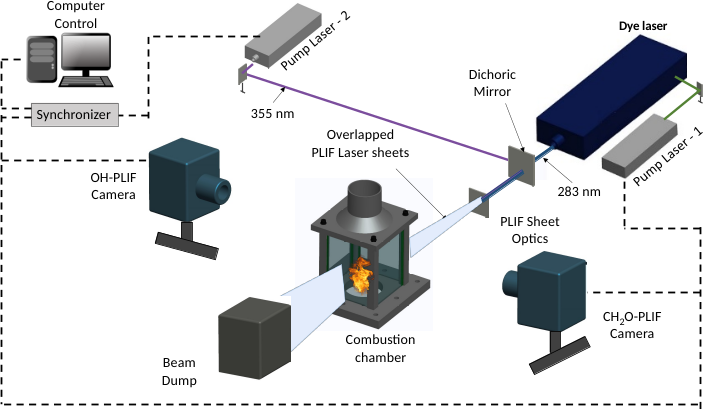
Simultaneous PLIF layout: two pump lasers and a dye laser produce 283 nm and 355 nm sheets combined through a dichroic mirror into the combustion chamber, imaged by OH-PLIF and CH2O-PLIF cameras on a common synchronizer
Simultaneous OH- and CH2O-PLIF: 283 nm and 355 nm sheets overlapped in the same plane
  • Planar Sauter mean diameter of the Jet-A1 spray
  • Kerosene PLIF to map fuel distribution and equivalence ratio
  • Simultaneous OH- and CH2O-PLIF for the planar heat release rate
  • Simultaneous high-speed OH-PLIF and PIV for flame–turbulence interaction
  • A flame stability map across inlet pressure, temperature and Mach number

The diagnostics build on the lab's time-resolved PIV/PLIF facility used for lean premixed combustion.

Funding

  • Aeronautics Research and Development Board (ARDB)Experimental characterization of flame stabilization in a jet engine afterburner, ₹10.19 crore, 2024 – 2027

People

  • Keshav YadavFlame stabilization in a jet engine afterburner (PhD, PMRF)
  • Prof. A. C. MandalCo-investigator, Aerospace Engineering, IIT Kanpur