Research · Turbulent combustion modeling

LES-ESF approach for turbulent reactive flows

The Eulerian Stochastic Fields (ESF) method brings a transported probability density function into large eddy simulation without Lagrangian particles. We develop ESF solvers in OpenFOAM and use them to simulate lean premixed gas turbine combustors, including self-excited combustion instability.

Background: LES-ESF axial velocity in the PRECCINSTA combustor

The approach

In LES the chemical source term depends on the unresolved, sub-filter fluctuations of temperature and composition. A transported filtered density function (FDF) closes this term exactly, but solving for it directly is expensive.

ESF represents the FDF with a small ensemble of stochastic fields. Each field is a full set of species and enthalpy, solved on the same LES grid as an ordinary transport equation with an added stochastic (Wiener) term and a micromixing term. Averaging over the fields gives the filtered composition and its fluctuations, while the reaction rates are evaluated exactly in each field.

Because everything stays on the Eulerian mesh, ESF fits naturally into a finite-volume code, handles complex combustor geometries, and parallelizes like the flow solver itself.
Validation: the PRECCINSTA combustor

The DLR PRECCINSTA swirl burner is a standard test case for lean premixed methane–air combustion and its thermoacoustic instability.

LES-ESF of PRECCINSTA: temperature, mixture fraction and axial velocity

Two operating points test whether the solver can tell a stable flame from an unstable one. At 25 kW the flame stays stable; at 30 kW and a richer mixture the simulation develops a self-sustained oscillation at 290 Hz, as in the experiments.

PowerφAir (g/s)CH4 (g/s)Flame
25 kW0.7012.230.500Stable
30 kW0.8312.230.598Self-sustained oscillation, 290 Hz
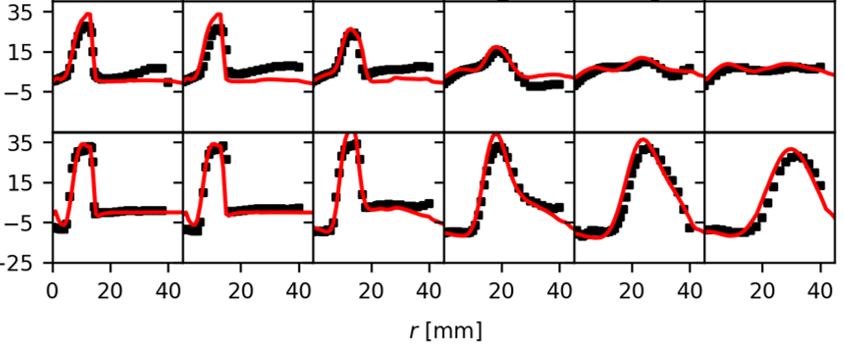
Two rows of velocity profiles at six heights above the dump plane, simulation lines against measured symbols
Velocity profiles (m/s) at 1.5, 2.5, 5, 15, 25 and 35 mm above the dump plane: LES-ESF (lines) against measurements (symbols)
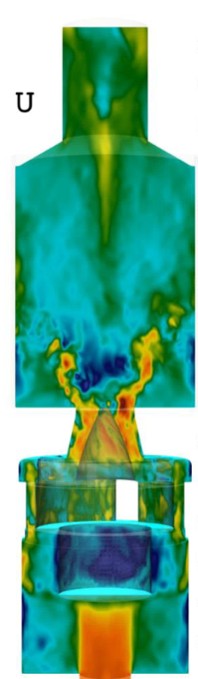
Velocity magnitude through the PRECCINSTA plenum, swirler, nozzle and combustion chamber
Instantaneous velocity through the plenum, swirler and chamber
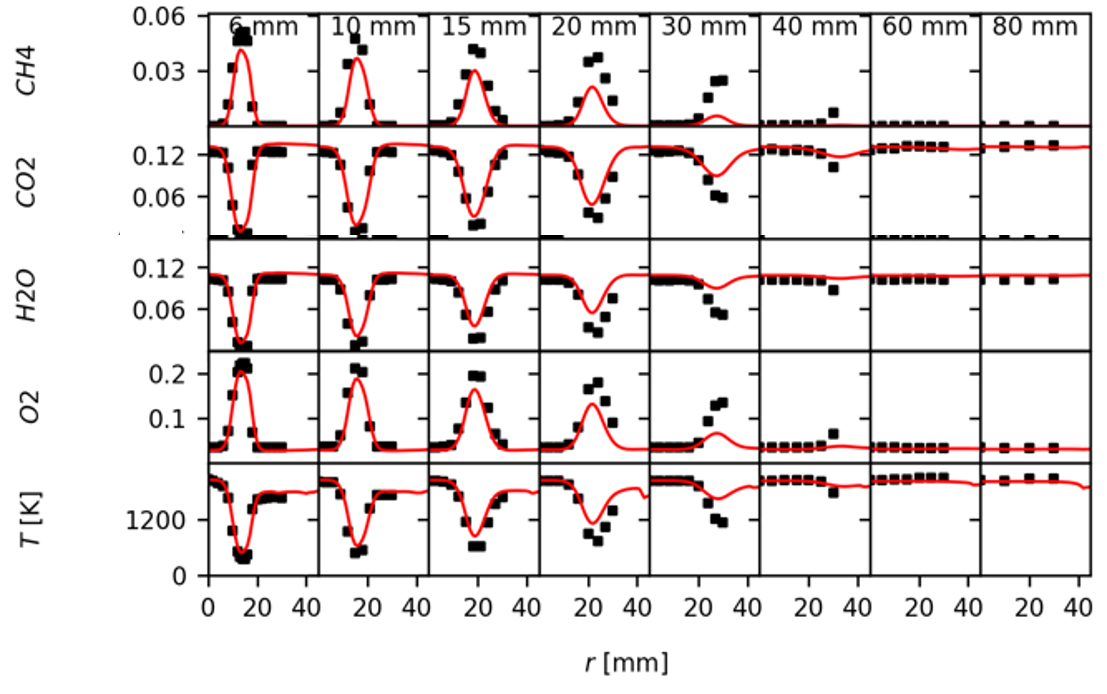
Radial profiles of CH4, CO2, H2O, O2 mass fractions and temperature at eight heights compared with measurements
Stable case: radial profiles of CH4, CO2, H2O, O2 and temperature at 6 to 80 mm, LES-ESF (lines) against measurements (symbols)

Velocity, temperature and the major species follow the measurements through the flame region. The largest differences appear around 20–30 mm, where the outer flame branch is thin and most sensitive to the turbulence–chemistry closure.

Applications and extensions

Our own combustor

Hydrogen-enriched swirl flames

The validated solver is used to model the lab's lean premixed swirl combustor, alongside the OH-PLIF and PIV experiments on CNG/H2 flames. See lean premixed combustion.

Instabilities

Thermoacoustics

LES with transported FDF closures is used to study thermoacoustic and hydrodynamic instabilities in lean premixed gas turbine combustors.

Sprays

Primary atomization

An LES Σ-Y model for primary atomization, built on the Eulerian stochastic fields framework, tracks the liquid–gas interface density in the near-nozzle region.

Power generation

Micro gas turbine combustors

Combustion simulations supported the design of the lean premixed combustor for the 100 kWe recuperated micro gas turbine.

People

  • Sarvesh MauryaLES-ESF simulations of turbulent combustion
  • Krishna Chaitan MarthiThermoacoustic and hydrodynamic instabilities in lean premixed combustors
  • Shakti YadavLES Σ-Y model for primary atomization with ESF (dual degree, 2019)

Recognition

  • First Prize, Poster, ASME GT India 2023K. C. Marthi and S. De, “Large eddy simulation of a partially-premixed swirl-stabilized combustor using transported filtered density function approach”

Funding

  • DST Hydrogen & Fuel CellLean premixed swirl-stabilized combustor for high-hydrogen-content fuel, 2020 – 2025