
Science and Technology behind Sustainable Metals Production: How to Extract Metals Efficiently Yet Sustainably
Research Statement
The High Temperature Chemical Processing (Hi-Temp) laboratory at IIT Kanpur conducts research in the broad area of process metallurgy with emphases on, but not limited to, iron and steelmaking processes. Currently, our group focusses on two major themes viz. i) H2-based reduction of iron oxides at moderate temperatures for sustainable steelmaking and ii) Development of mould fluxes for continuous casting of challenging and innovative steel grades. Other areas of interest include Refractory interactions and Modelling of unit operations in integrated steelmaking and Ti-sponge production. (Please see below for more details about these themes)
Themes:
i. H2-based reduction of iron oxides at moderate temperatures for sustainable steelmaking
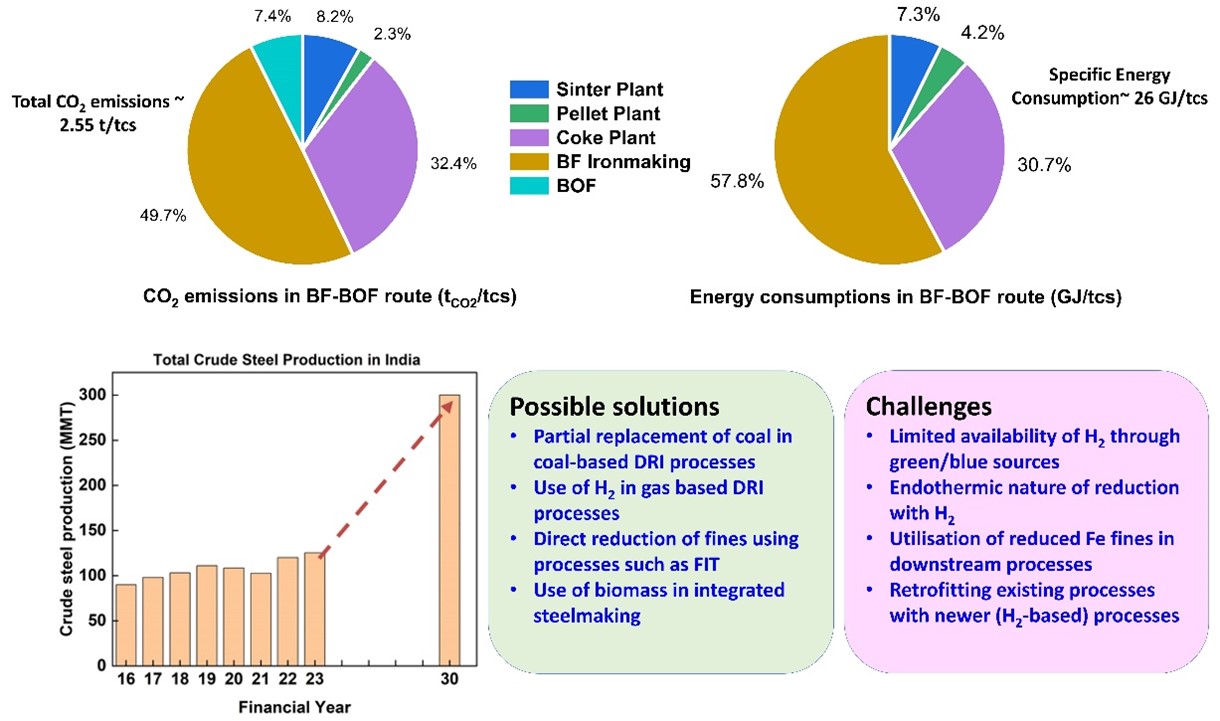
While technologies to produce iron and steel from natural resources are well known, these technologies are often very energy intensive. Additionally, they emit significant amounts of CO2 to the environment. Global averages of energy requirement and CO2 emissions, for each per tonne of crude steel produced, are ~18 GJ and ~ 1.85 tonnes respectively. Multiply these with the global production of 1.9 billion metric tonnes of crude steel and you will get colossal figures which account for nearly 7% of the global energy consumption and 8% of the global CO2 emissions respectively! Corresponding values for the Indian iron and steel industry are much higher mainly due to the poor quality of raw materials and the problems with retrofitting of modern technologies in old plants. With India’s ambitious plan of producing 300 million tonnes of steel by 2030, which is more than twice the current production, drastic measures need to be taken to reduce the CO2 emissions from the iron and steel industry. This calls for exploring alternative technologies for producing iron and steel.
In the Hi-Temp laboratory, we are exploring the idea of using H2 as a reducing agent in alternative ironmaking processes such as the flash ironmaking technology (FIT) and a (proposed) horizontal moving reactor-based technology. Using H2 based technologies offer two distinct advantages. First, a significant reduction in CO2 emissions is possible. Secondly, considerable reduction in the energy requirement, to the tune of 40%, is achievable. Furthermore, technologies such as Flash Ironmaking can directly use iron ore fines without requiring agglomeration. This is expected to cause a further reduction in the energy requirement and CO2 emissions. However, using H2 for iron ore reduction has some challenges, the most important among which are the endothermic nature of the overall reduction reaction and limited availability of H2-gas from green and/or blue sources. In the Hi-Temp laboratory at IIT Kanpur, we are trying to address these challenges using experimental and computational tools.
ii. Development of mould fluxes for continuous casting of challenging and innovative steel grades
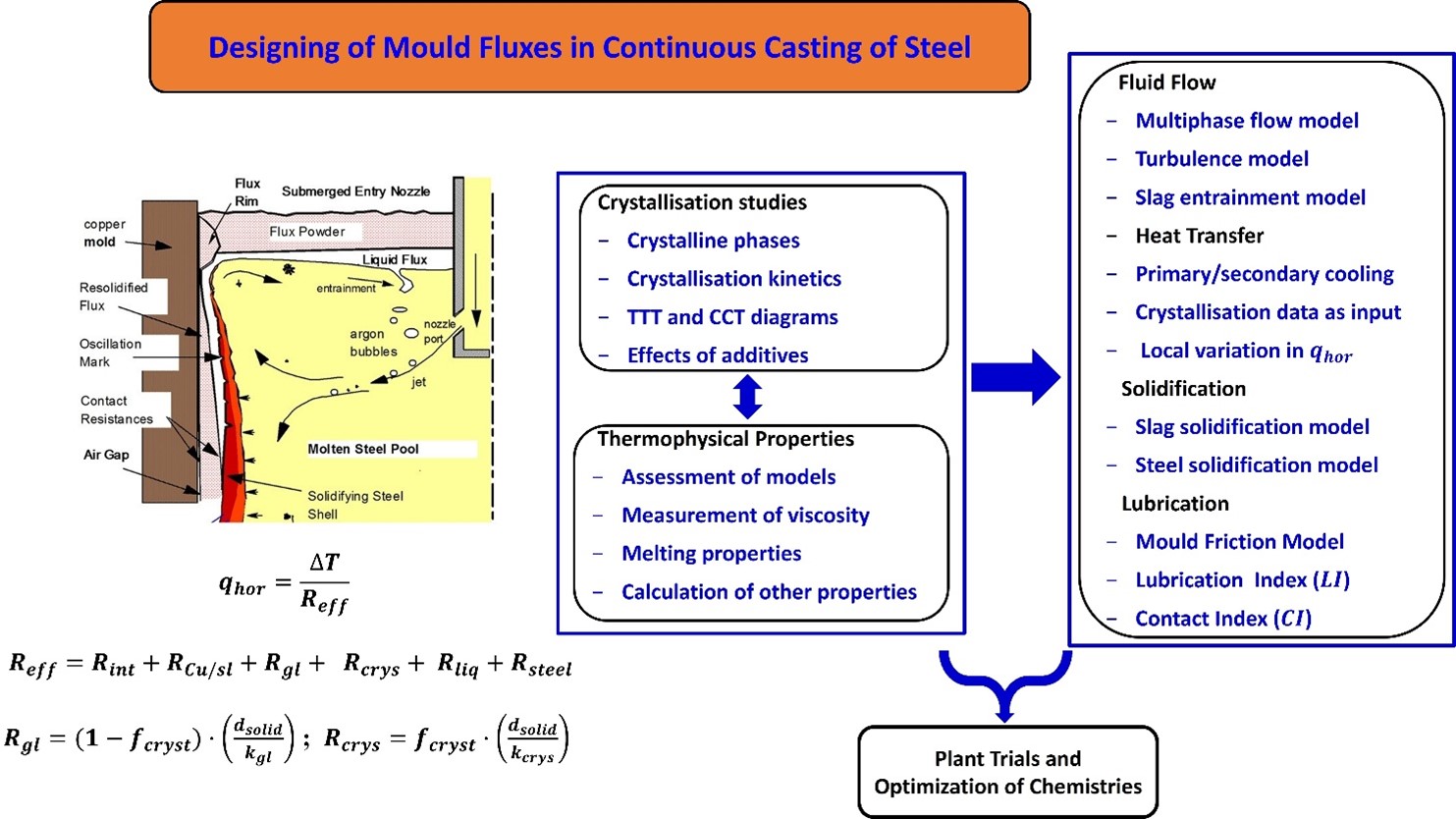
In the continuous casting (CC) process of steel, the steel shell tends to stick to the copper mould unless measures are taken to prevent it. The use of casting powders, or mould fluxes, as they are more commonly known, is one of most important measures taken to prevent the sticking of the shell to the mould. These powders are gradually heated up and create a pool of liquid flux, a significant amount of which enters the gap between the mould and the shell. Over time, it freezes against the mould to form a solid slag film thus leaving behind a thin liquid film against the steel shell. After sufficiently long times, the slag film consists of a combination of a glassy phase and crystalline phase(s)
The selection of appropriate chemistries for mould fluxes is grade-specific and plays a critical role in the continuous casting process. In our laboratory, we are involved in the development of mould fluxes for challenging and innovative steel grades for which conventional mould fluxes, based on the CaO-SiO2 system, is often found unsatisfactory. Currently, we are involved in developing alternative mould fluxes for 3rd generation of Advanced High-Strength Steels (AHSS), high-Al ferritic stainless steel and medium carbon peritectic steels.
iii. Refractory Interactions in Iron and Steelmaking
Refractories are the primary materials used for the internal linings of furnaces in pyrometallurgical operations. Aluminosilicates and Carbon/Graphite form the two major classes of refractory materials used in ironmaking processes while Magnesia-based basic refractories are mostly used for steelmaking applications. Refractory selection and design play an important role in the successful operation of any technology, particularly in newer and alternative technologies. In our laboratory, we are interested in understanding the interactions between different refractories and the metal, slag and gas phases from a mechanistic standpoint. To this end, we perform high-temperature experiments under controlled environment to determine the rate of such interactions and develop kinetics models to explain the observed rates. Since the interactions are often controlled by solid-state diffusion, our studies yield useful information about the parameters for solid-sate diffusional processes, such as the interdiffusion coefficient and its composition dependence thereof. We have previously investigated the interactions between iron, iron oxide and slags with Alumina and Magnesia-carbon refractories under flash ironmaking conditions. More recently, we studied the oxidation behaviour of blast furnace trough refractories.
iv. Modelling of Unit Operations in Integrated Steelmaking and Ti-sponge production
Due to complex nature of the unit operations involved in integrated steel production, mathematical models and simulations are often used to understand various aspects of such processes, from blast furnaces to steel converters to continuous casters. Such models play a critical role in iron and steelmaking, helping in process optimization and new product development. In our laboratory, we are developing models for these processes such as BOF (LD-Converter) steelmaking and external DeS using powder co-injection. Apart from ferrous processes, we, in collaboration with the research group of Prof. A. K. Singh, are also involved in developing process models for unit processes in Ti-sponge production using the Kroll’s Process.
If you interested in one of the above themes, please feel free to contact me at rsarkar@iitk.ac.in