Technology Transferred to M/S Raman Mahana Brick Manufacturer, Lal Bangla, Kanpur, U.P.- 208007
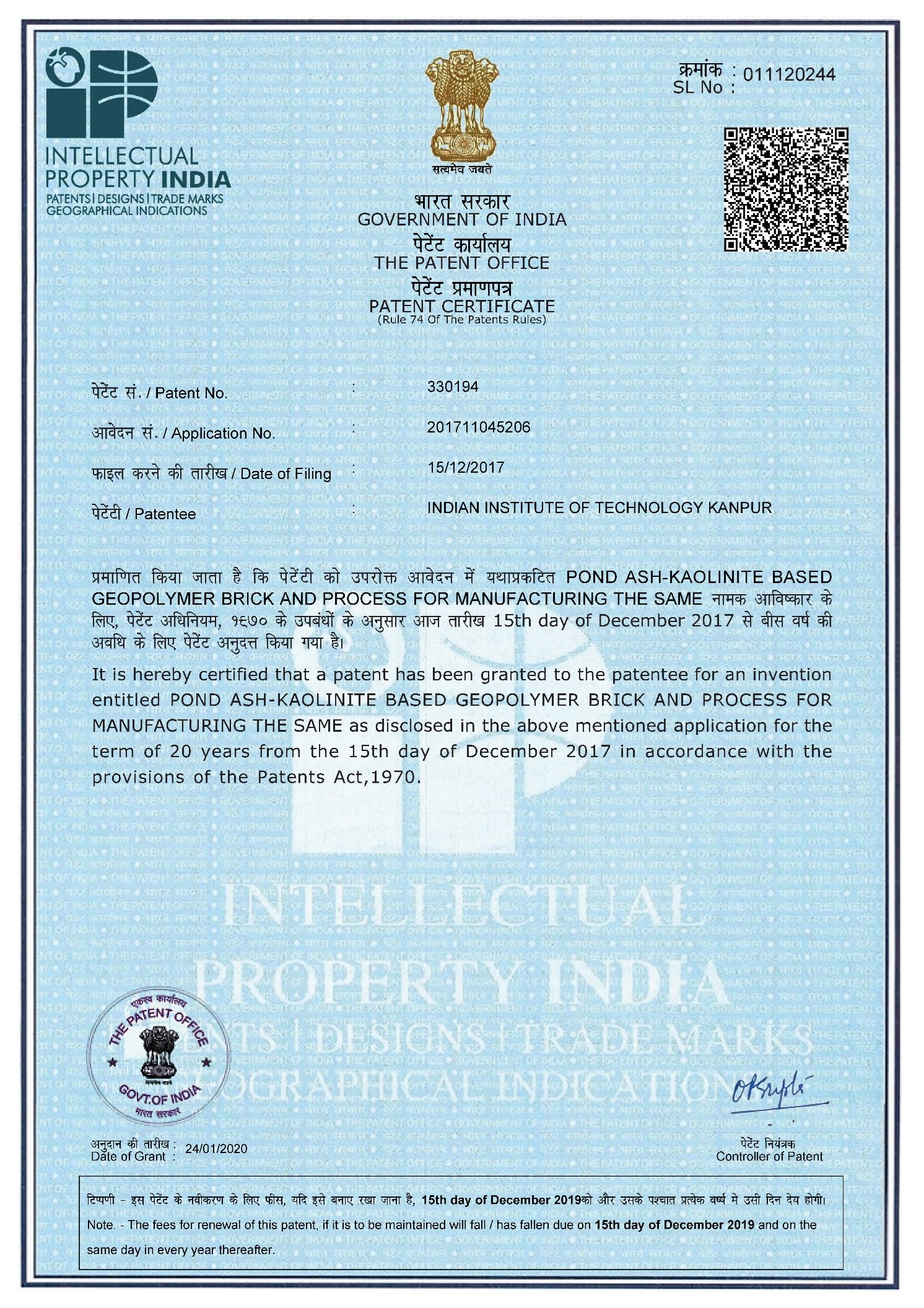
The nominee has developed a novel technique for utilization of pond ash generated from power plants in the form of a brick for usage in geotechnical applications. The utilization of pond ash, which is waste product, has been a great concern in India over the last two and half decades, though its production from the combustion of coal in different thermal power plants has considerably increased. Such a large volume of pond ash poses problems of disposal, health hazards and ecological threat as it consists of very light weight fine particles, which can be easily transported by air in dry state and its disposal requires a large quantity of land, water and cost. Presently, the pond ash is generally used for landfilling purpose in India. The proposed technology has the potential to utilize pond ash in a large scale, thus negating the effects of pond ash pollution.
The current technology used for manufacturing the bricks consumes lot of fuel for burning and thus, causes air pollution. Whereas, the geopolymer bricks are oven dried at 65˚C, making the proposed technology as a green one with reduction in the fuel consumption and air pollution. On the other hand, the manufacture of bricks by present technology utilizes lot of clay.
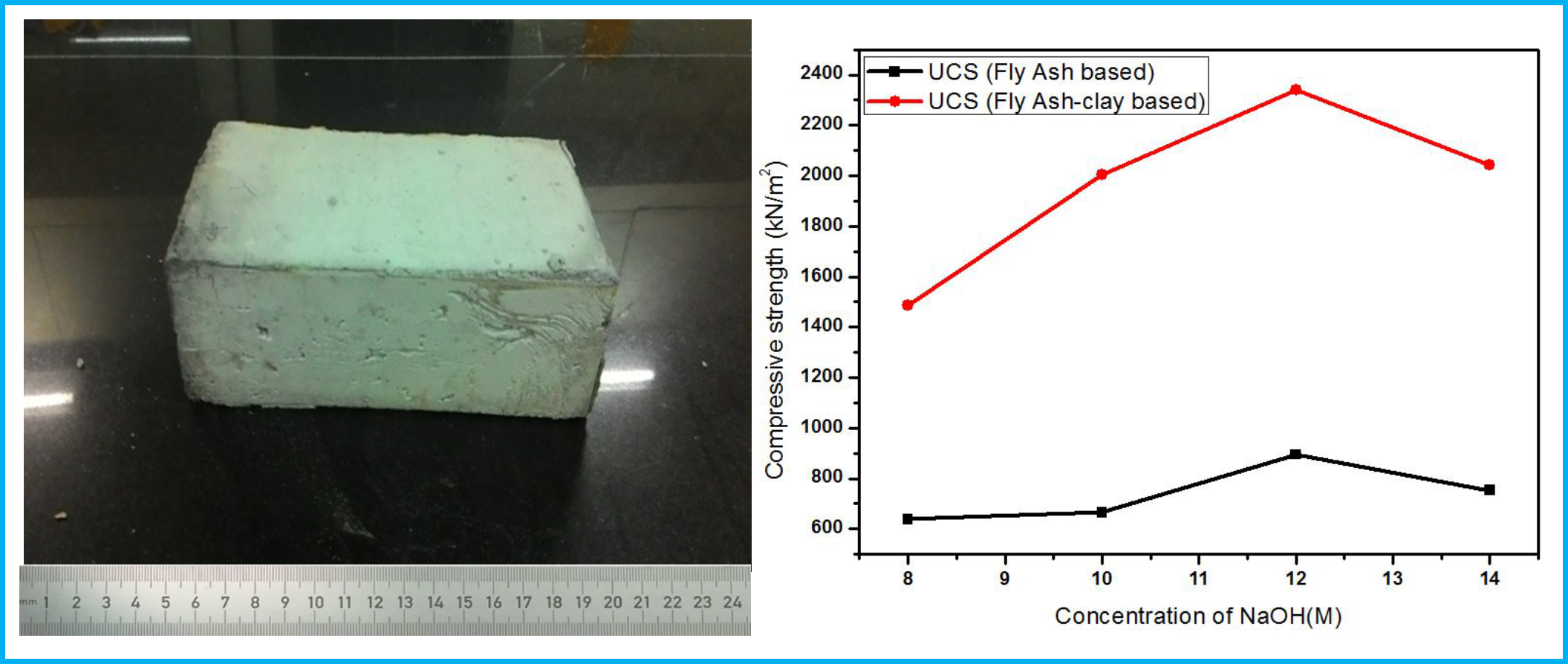
Figure 1: (left) a typical brick prepared and (right) the compressive strength of the brick as a function of concentration of alkali activator.
Multicomponent High Entropy Diborides Bulk Ceramics using Boro-carbothermal Reduction of the Corresponding Metal Oxides
The space shuttles and re-entry vehicles are work horse for space exploration in which Indian Space Research Organization is actively involved. The survival of these space vehicles requires usage of materials which can withstand ultra high temperature (>2000°C) in an oxidative and corrosive atmosphere. Hence, the need for development of new materials with improved performance is always desired. The present invention involves a new material for ultra high temperature application. It consists of multiple metallic species as di-boride [(M1,M2,M3,M4)B2], which has been synthesized from the mixture of individual oxides reacting with boron carbide (B4C) and sintered simultaneously at relatively lower temperature (1750°C vs 2000-2200°C) by using special sintering route. The material synthesized exhibit good mechanical property.
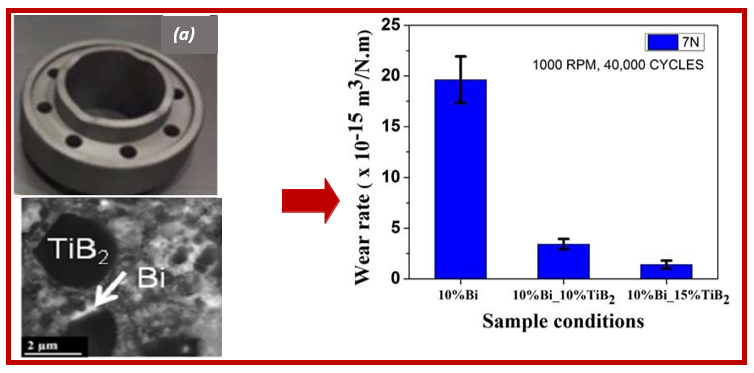
Figure 2: (a) Bearing manufactured using (AlCrFeMnV)90Bi10/TiB2 composite and (b) wear rate of the composite in comparison with other materials (AlCrFeMnV)90Bi10, AlCrFeMnV)90Bi10-(TiB2)10, AlCrFeMnV)90Bi10-(TiB2)15
The key objective of this invention is to synthesize Multicomponent High Entropy Diborides bulk ceramics using Boro-carbothermal reduction of the corresponding metal oxides at a lower temperature (Temperature range: 1750°C -1850°C). This kind of similar approach can also be used for synthesizing other high entropy borides from transition metal oxides such as HfO2, TiO2, Ta2O5, MoO2, WO2, Nb2O5, ZrO2, V2O5, and Cr2O3. As a representative of this approach one particular composition of multicomponent diboride (Nb0.25Ti0.25Cr0.25Zr0.25B2) is prepared from the mixture of several metal oxides (Nb2O5, TiO2, ZrO2, and Cr2O3) via Boro-carbothermal route using B4C as a reducing agent followed by in-situ reactive spark plasma sintering for application as a potential material for thermal protection system in re-entry vehicle. This multi-component ceramic material was synthesized via 2-step in-situ reactive spark plasma sintering at a temperature of 1800°C where the reaction between the reactants and densification takes place simultaneously. Both the X-ray Diffraction study and microstructural investigation revealed a fully formed homogeneous solid solution diboride. The above-mentioned material is prepared with the implementation of specially designed experimentation at a lower temperature where other reported temperature is higher than this.
Multicomponent High Entropy Alloy Composite for Bearing Applications
The present invention provides a novel self-lubricating multicomponent multiprincipal High Entropy Alloy (HEA) composite (AlCrFeMnV)90Bi10/TiB2 for bearing applications. In the present invention, a new alloy composition (composition of matter) has been designed and synthesized successfully to obtain a gear assembly. The alloy composite was synthesized via combination of mechanical alloying and spark plasma sintering routes. The microstructural characterization reveals the homogenous dispersed solid lubricant Bi and TiB2 in the HEA matrix. The alloy composite than successfully machined into gear and wear behavior of gear was studied in dry ambient condition under different normal load and sliding speed. The above mentioned material exhibited the excellent wear resistance. The observed wear rate was of the order of 10-15 (mm3/N m), which is much lower than available bearing materials. Thus, by proper combination of soft and hard dispersoid it has been possible to achieve the improved wear behavior.
Figure 2: (a) Bearing manufactured using (AlCrFeMnV)90Bi10/TiB2 composite and (b) wear rate of the composite in comparison with other materials (AlCrFeMnV)90Bi10, AlCrFeMnV)90Bi10-(TiB2)10, AlCrFeMnV)90Bi10-(TiB2)15
(AlCrFeMnV)90Bi10/TiB2 composite. Al20Cr20Fe20Mn20V20 is an equiatomic multiprinciple multicomponent alloy has BCC (body centered cubic) structure. The composite contains 10 wt% Bi as soft lubricant and 10 wt% TiB2 as hard phase. Therefore it is a novel self-lubricating HEA alloy composite composition has been designed and synthesized successfully, which has soft and hard lubricants in the HEA matrix. The alloy composite is easy to process into different shapes and sizes, exhibiting high hardness, sufficient ductility and excellent wear resistance. The combination of novel processing routes has been utilized to obtain uniform distribution of dispersoids, finer grain size of the matrix in the material. This involves first ball milling Al20Cr20Fe20Mn20V20 till 25 hours to obtain single phase (Body Centered Cubic) alloy. Size of Bi and TiB2 powder particles have been reduced via ball milling up to 4 hours. Subsequently, nanocrystalline Bi and TiB2 powder obtained has been added to Al20Cr20Fe20Mn20V20 alloy powder and ball milled for another 10 hours to obtain a homogeneous mixture. This powder was then sintered using Spark Plasma Sintering facility at 900oC with holding time of 5 minute and heating rate of 100 K/min. The sample was cooled normally until room temperature and sample was extracted from the graphite dies/punches.
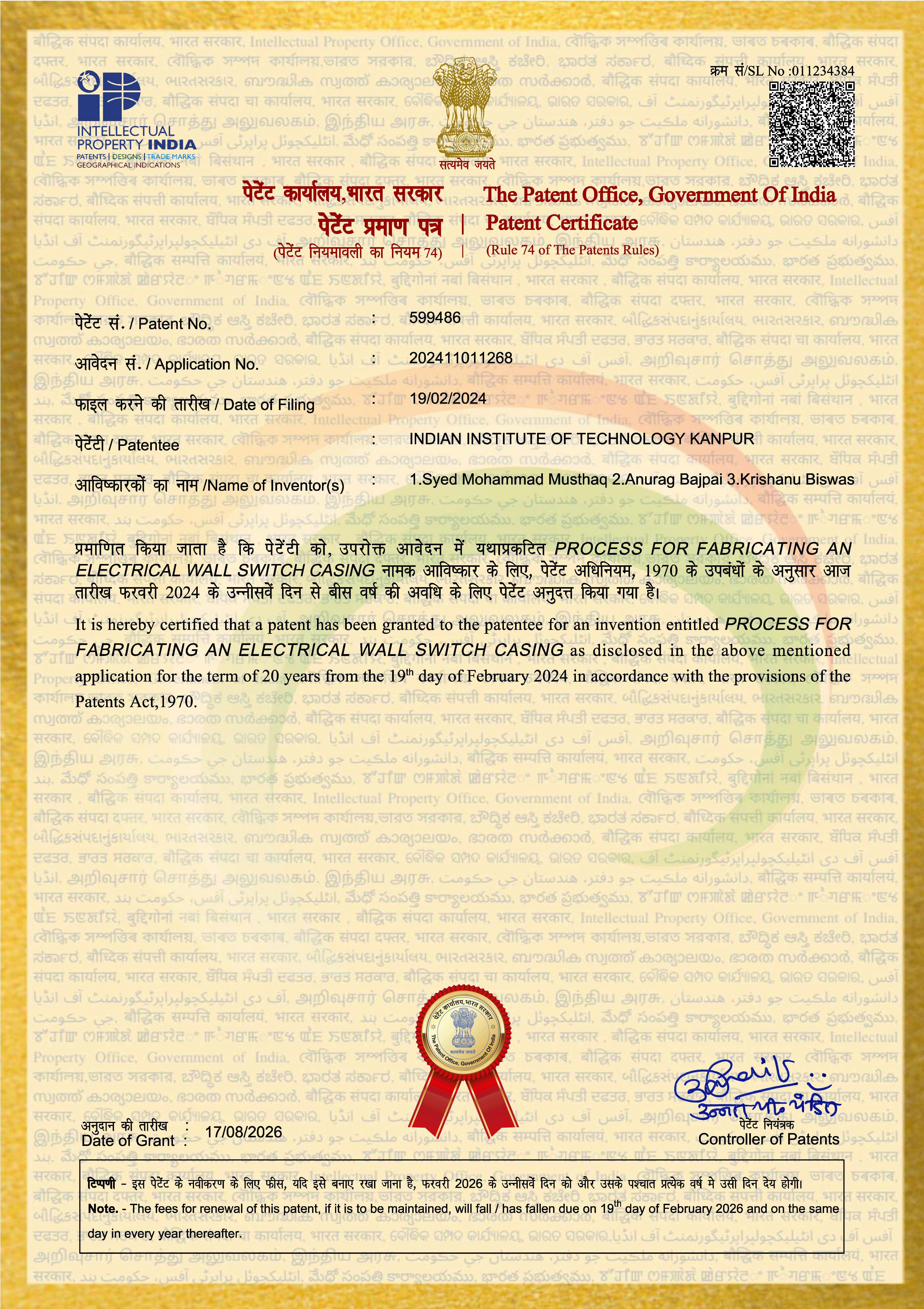
Process for Fabricating an Electrical Wall Switch Casing
The concept of 'Waste-to-Wealth' is always of tremendous interest for various reasons, more so for electronic waste, which has emerged as the fastest-growing waste stream. Though e-waste consists of waste electronic and electrical equipment of varying sizes, those with a small life span add the major weight to the growing pile of e-waste. These expendable equipments include mobile phones, tabs, computers, and electronic accessories.
In this backdrop, the present research establishes an easily scalable green route for beneficiation and practical usage of constituent materials from the components of e-waste using cryo-temperature ball milling followed by physical separation. The waste printed circuit boards (PCBs) have 40% (by weight) metallic component, 30% polymeric component, and the remaining is ceramic residue.
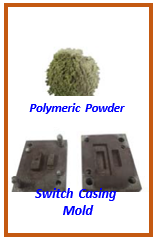
The waste PCBs were mechanically segregated based on the size and density of the components. They were then broken down into small pieces of 4-6 mm size using a grinder. The dismantled PCBs were ball milled at -160±10°C, maintained using liquid nitrogen. Further, the components of PCBs were separated from each other by density separation of the polymeric powder switch casing mold milled powder, using repeated filtration and magnetic stirring in distilled water. While the heavier metallic residue settled at the bottom of the flask, the polymeric component remained at the top, which was subsequently removed and dried separately. This procedure was repeated several times in order to obtain maximum recovery of both metallic and polymeric powders. The proposed process has shown the ability for near-net recovery of these constituents without using any non-biodegradable substances or chemicals. Attempts have been made to scale up the use of the polymeric component of waste PCBs to produce electrical switch casings through the compression moulding technique. Since the significant component of this polymeric residue is polycarbonate, a really strong and heat resistant plastic, such electric switch casings can exhibit good performance in operation (Patent to be filed soon). In a nutshell, the current approach can provide a useful means of recover and utilize major components from e-waste, which can then be used to produce green energy, valuable materials such as graphene, and for engineering applications in an environmentally friendly manner, making the process sustainable, reducing pollution burden on mother Earth and protect the future generation.